Passing the Certification Test
A young rider may be ready for an ATV or UTV but still need an OHV safety certificate before riding on public land. The process can involve an online course, an in-person class, or a fully online option, and those routes are not identical. Here’s how to choose a path, prepare for the test, and understand what certification does—and does not—allow.
Who needs an OHV safety certificate
North Dakota requires youth without a valid driver’s license or learner’s permit to take an OHV safety certification class to operate on certain allowed public lands. The North Dakota Parks and Recreation Department describes the requirement in its guidance as applying to youth ages 12 to 16, and also refers to youth ages 12 through 15. Because the wording spans different age descriptions, confirm the current requirement directly with the department if the rider is 16.
Certification is not simply a recommendation for safer riding. According to the North Dakota Parks and Recreation Department, it is required for youth who need it to legally operate an OHV on land other than a parent’s, including designated trails and ditches. Riding on a parent’s land is treated differently; see North Dakota Riders on a Parent’s Land for that specific situation.
The minimum age to become certified is 12, according to the North Dakota Parks and Recreation Department. A child who is 11 but will turn 12 within six months of a class date may take the hands-on course or test, but the department does not issue the certification card until the child turns 12. That exception can help a family plan ahead, but it does not mean the child can receive the card early.
The rules apply to OHVs, including dirt bikes, ATVs, and side-by-sides. The department identifies Class I OHVs as motorcycles or dirt bikes, Class II as ATVs, and Class III as UTVs or side-by-sides. The safety certificate question is separate from the vehicle’s class, registration, and where it may be ridden.
Certification also does not replace other riding requirements. OHVs operated on public land generally must be registered with the North Dakota Department of Transportation, according to the North Dakota Parks and Recreation Department. Out-of-state registered OHVs need a non-resident public trails and lands access permit, according to the same department. For the broader distinction between training, registration, and access, see North Dakota Registration and Trail Access and North Dakota Permits for Visiting Riders.
Choose the course route before you study
There are two ways to complete the safety training: take the introductory online course and then attend a hands-on class, or complete the full course online. The right choice depends on whether the student wants practical instruction and whether an in-person class is available at a convenient time.
| Course route | What to expect | What to prepare |
|---|---|---|
| Introductory e-course plus hands-on class | Complete the online introduction first, then attend the in-person session | Bring the e-course certificate number and required clothing and eye protection |
| Full online course | Complete the entire safety course online | Check the course instructions for access, completion, and certificate details |
The hands-on route is not a walk-in alternative to the introductory course. The North Dakota Parks and Recreation Department requires students to complete the introductory e-course online before attending and to bring their certificate number. Complete that step early enough to find the number and resolve any login or completion issue before class day.
The fully online route is different: it is the complete certification course rather than only the introduction. The North Dakota Parks and Recreation Department lists the full online course fee as $34.95 as of November 2026. The department offers its hands-on course for free. Check the department’s current course information before enrolling, since course availability and payment details can change.
If the student prefers in-person instruction, plan around the season. According to the North Dakota Parks and Recreation Department, hands-on OHV safety sessions are held from May through August, and each in-person class is limited to eight participants. Small class size can allow for direct practice, but it also means families should look for a session early rather than assuming a spot will be available at short notice.
The department says agency or private-industry OHV and snowmobile safety classes take approximately four hours. That gives families a useful planning estimate, not a promise that every session will follow an identical schedule. Confirm the location, arrival time, and any additional instructions with the course provider.
For a closer look at the state’s training options, North Dakota Safety Training Run by the State and North Dakota Online Safety Course Option cover related details. Students who need to check the status of a completed course can also consult North Dakota Safety Certificate Lookup.
Prepare for the test and class
The best preparation is to complete the required course material carefully and follow the provider’s instructions. The supplied information does not specify a passing score, a fixed number of test questions, a retake limit, or a guaranteed test format. Don’t rely on guesses about those details; check the course platform or ask the instructor what to expect.
For the online portion, set aside time to work through the material without rushing. Pay attention to the safety and riding rules rather than treating the course as a memory exercise. If a question is unclear, review the relevant lesson before moving on. Save or write down the completion details the course provides, especially the certificate number needed for a hands-on class.
If the student is attending in person, the North Dakota Parks and Recreation Department requires over-the-toe shoes, long pants, and a long sleeve shirt. Students must bring their own eye protection. Check that it fits securely and is suitable for the riding exercises, and confirm any class-specific equipment directions before leaving home.
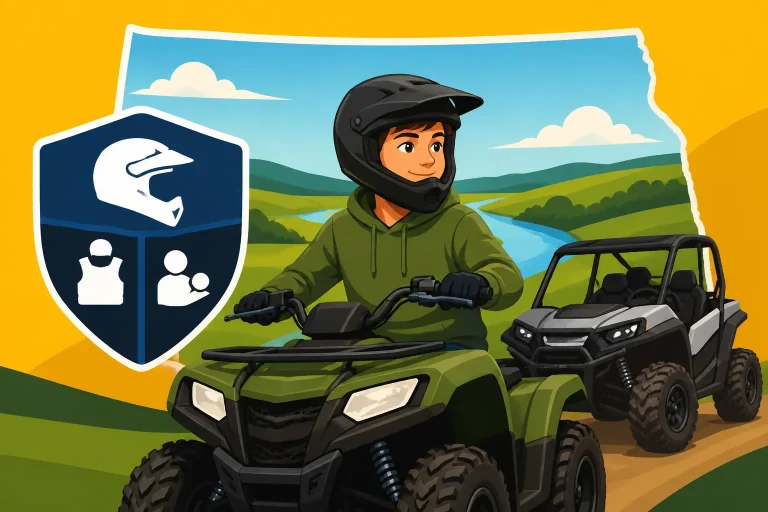
A helmet is provided at the beginning of the hands-on course for students to keep, according to the North Dakota Parks and Recreation Department. That is useful for students who do not already have a helmet, but it does not remove the need to wear the right gear on later rides. Riders and passengers under age 18 must wear a DOT-approved helmet when riding an OHV, including a dirt bike, ATV, or side-by-side, according to the department.
Before class, it can help to review the machine the student expects to ride and the basic controls, if the instructor allows that preparation. Do not assume the student needs to bring a personal machine: confirm that with the course provider. Likewise, don’t assume that a certificate automatically authorizes the student to operate any vehicle or ride anywhere. Training is one part of the rules, not a substitute for supervision, registration, permits, or land-access requirements.
For age-related questions, North Dakota OHV Safety Certificates at Age 12 explains the minimum-age issue, while North Dakota Rules for Riders Under 16 is useful for the separate rules that may apply to younger operators. These details matter because passing the course does not make every other age-based restriction disappear.
What passing means for your next ride
Once a student completes the required course and receives certification, keep the certificate information accessible. The department’s certificate lookup information may help if the physical card is misplaced, but check what proof the rider is expected to carry or present. For a hands-on student who qualified to take the course at age 11, remember that the card is issued only after the student turns 12, according to the North Dakota Parks and Recreation Department.
Certification addresses training; it does not serve as an OHV registration or an access permit. The North Dakota Parks and Recreation Department says all riders must be properly registered or permitted to ride legally in North Dakota. Residents generally need the applicable state registration for public land and trail use, while owners of out-of-state registered machines need the non-resident access permit. Verify what applies to the machine and rider before heading out, especially if the OHV is visiting from another state.
Nor does a safety certificate make a road legal for OHV use. Road operation has its own requirements, and conditions differ from trail riding. For example, the North Dakota Parks and Recreation Department says roadway operation requires a motor of at least 350 cubic centimeters. Other rules apply to vehicle class, roadway designation, equipment, and operator eligibility. Review North Dakota ATV Road Rules by Surface Type before treating a public road as part of a riding route.
A practical pre-ride check can help prevent a successful course from turning into an avoidable problem:
- Confirm the rider has completed the required certification and can provide proof if asked.
- Check that the OHV has the correct registration or permit for its ownership and registration status.
- Confirm that the planned land or trail is open to OHV use and that the rider has permission where required.
- Make sure the rider has the helmet and protective gear required for the ride.
- Review any additional rules that apply to the machine, location, or rider’s age.
For parents, the main takeaway is to treat certification as a starting point. A young rider still needs an appropriate machine, clear boundaries, suitable supervision, and a route that is legal for that vehicle. Read the course instructions closely, plan ahead for a hands-on session if that is the preferred route, and confirm any detail that could affect eligibility or access before the ride.
Sources
- North Dakota Parks and Recreation Department — OHV Safety | ND Parks and Recreation – Business and Grants (checked November 3, 2026)
- North Dakota Parks and Recreation Department — Motorized Safety | North Dakota Parks and Recreation (checked November 3, 2026)
- North Dakota Parks and Recreation Department — OHV Trails | ND Parks and Recreation – Business and Grants (checked November 3, 2026)
- North Dakota Parks and Recreation Department — Snowmobile Safety | ND Parks and Recreation – Business and Grants (checked November 3, 2026)
- North Dakota Parks and Recreation Department — Snowmobile Trails | ND Parks and Recreation – Business and Grants (checked November 3, 2026)
- North Dakota Parks and Recreation Department — 04-2022%20OHV%20Brochure%20WEB.pdf (checked November 3, 2026)
Disclaimer
This article is for general informational purposes only and does not constitute professional advice. Laws, prices and regulations vary by location and change over time. Consult a qualified professional for guidance on your specific situation.