North Dakota Group Size on a Trail
A group ride in North Dakota can involve more than choosing a meet-up time: trail rules, land access, machine permits, parking and rider experience all affect the plan. There is no single group-size number that applies to every trail. Here’s how to check the rules for your destination and keep a large ride manageable.
Is there a statewide group-size limit?
North Dakota does not set one universal numerical group limit for every OHV trail. That does not mean any group can ride anywhere in any numbers. The trail or property manager may set site-specific conditions, and a special event or organized ride may require advance permission or paperwork.
Rules can also differ between places that look similar on a map. A marked trail, an open riding area and a route on public land may have different managers and access conditions. A group that is welcome on one route may need to split up, change its plan or choose another place at a different site.
Before settling on a headcount, check the rules for the specific riding area. Start with the site’s official information, then contact its manager if the rules do not address group size or a planned event. Ask about:
- Any limit on the number of machines travelling together
- Whether groups must use a particular trail or stay within a designated area
- Whether advance notice, a reservation or an event permit is required
- Parking capacity for trucks and trailers
- Temporary closures or restrictions
- Requirements for nonresident permits, safety certificates or landowner permission
Do not treat a group’s size as the only issue. A ride with several small subgroups may still count as an organized event if it is advertised, scheduled or open to participants beyond a private circle of friends. When in doubt, describe the plan to the land manager and ask what applies. North Dakota Event Permits for a Ride covers the separate question of paperwork for organized rides.
The riding area matters
North Dakota riding areas do not all offer the same kind of access. A designated trail may have narrow sections, gates or other features that make it difficult for a large convoy to travel together. An open play area may offer room to spread out but still have parking, access or use rules to follow. A route on public land may be limited to designated roads rather than cross-country travel.
For example, Pembina Gorge, Roughrider OHV Trail, Turtle Mountain and Kimball Bottoms are distinct riding destinations. Do not assume that an access rule or group practice at one transfers to another. Check the information for the place you plan to ride, including whether the route is open and what vehicles it accommodates. North Dakota Trail Closures After Rain and North Dakota Trailhead Parking Limits can help with two common planning questions: whether a route is usable and whether the group can stage there.
Permits and requirements for each machine
A group reservation or event approval does not replace the requirements that apply to individual machines and riders. Before the trip, make a list of the machines in the group and confirm that each one has the appropriate registration or permit for its situation.
North Dakota residents and visitors may have different requirements. A nonresident permit is not a general pass that covers every machine in a convoy; check the rules for each visiting machine. North Dakota does not have reciprocity with other states, so a home-state registration or sticker should not be assumed to satisfy North Dakota’s visitor requirements. North Dakota Non-Resident OHV Permit and North Dakota Has No Reciprocity With Any State explain those issues in more detail.
A quick pre-ride check might look like this:
| Check | What to confirm |
|---|---|
| Machine status | Each ATV or UTV has the registration or permit required for its owner and use |
| Visitor requirements | Each out-of-state machine meets North Dakota’s nonresident rules |
| Site access | The destination is open to the machine type and intended use |
| Rider requirements | Younger riders meet applicable safety-training and riding rules |
| Land access | The route is open and any required landowner permission is in hand |
| Event status | The ride is private recreation or has any required event approval |
For a mixed group, do not assume one person’s registration, permit or permission covers the rest. Check whether each machine needs its own documentation. If someone is borrowing a machine or joining with an out-of-state vehicle, confirm that machine’s situation before travelling. North Dakota Permit for a Visiting Machine is useful when a visitor is bringing a particular ATV or UTV.
Riders also need to be ready for the route and follow applicable age and safety rules. North Dakota has safety-certificate requirements for some younger riders; check the rider’s age and circumstances rather than assuming that adult supervision alone settles the question. See North Dakota OHV Safety Certificates at Age 12 for the certificate rules.
Land access is another separate check. A large group cannot ride across private land simply because a nearby public route is open. Confirm that the route itself is permitted, and get permission where required. For posted property, see North Dakota Posted Land Permission.
How to keep a group ride manageable
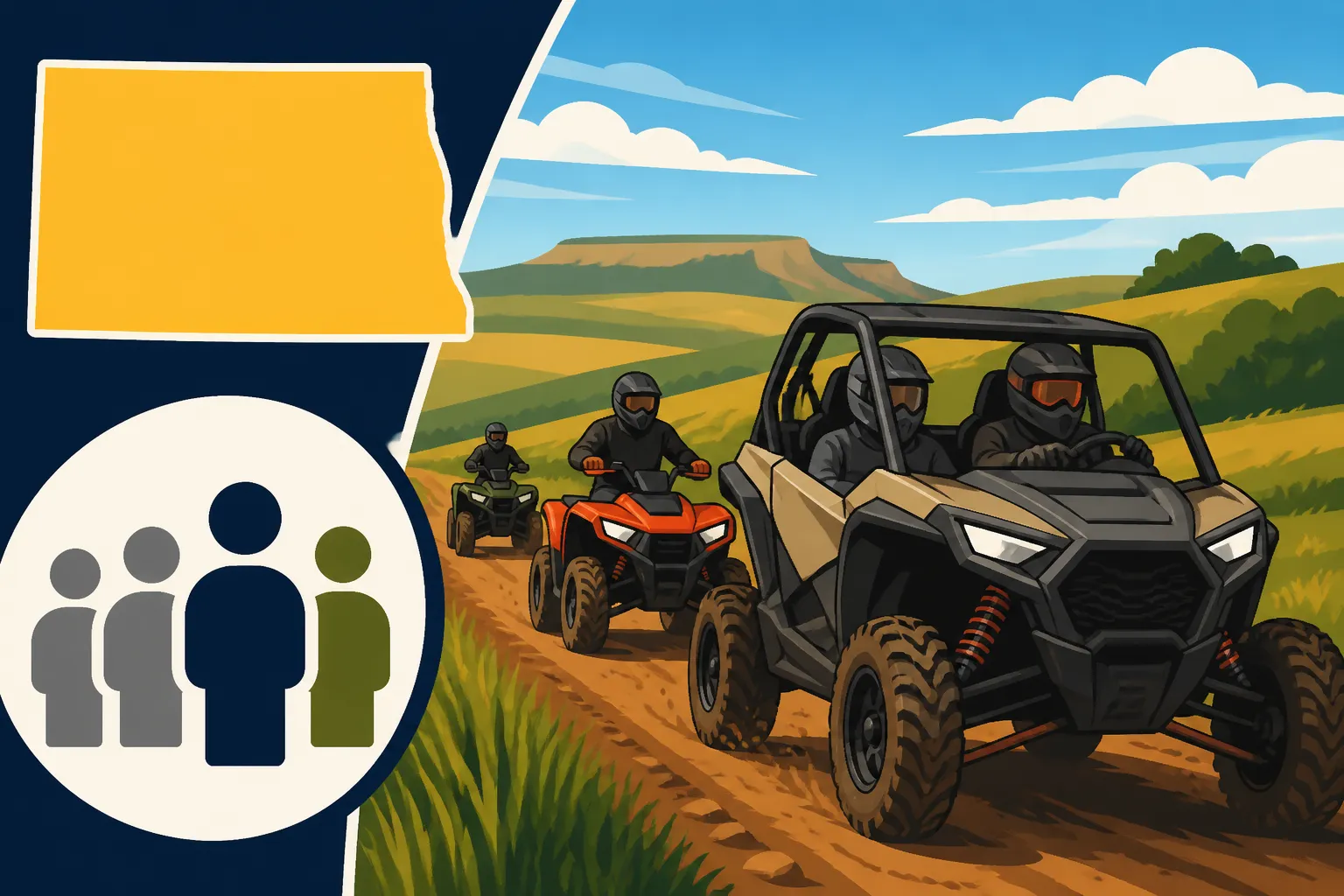
Even where a site does not set a numerical cap, a large group can be harder to control on a narrow trail or at a busy trailhead. Breaking the ride into smaller riding units is often the simplest way to reduce delays and prevent the group from blocking other users.
Split into riding units
Choose a practical size based on the trail, the riders and the machines, not on a number that someone assumes is a statewide rule. Smaller units can be easier to keep together through turns, gates and narrow sections. They also make it simpler to stop safely without occupying the entire route.
Agree on the plan before engines start:
- Choose a lead rider who knows the route and a sweep rider who stays behind the group.
- Divide the full party into smaller units, each with a named lead and a clear order.
- Set regrouping points where everyone can pull off without blocking trail access.
- Establish what to do if a rider falls behind, gets separated or has a mechanical problem.
- Make sure every rider knows the destination and how to contact the group.
The exact arrangement depends on the location and available communications. Do not rely on a phone signal in remote areas. If the group uses radios, agree on the channel and basic call procedure before leaving the trailhead. Carry a map or other route information that still works if devices lose service. North Dakota Group Ride Planning offers more planning considerations for coordinating a ride.
Keep the route and pace suitable for the least experienced rider
A group often includes different machine types, experience levels and comfort with terrain. Choose a route and pace that the least experienced rider can manage safely. A fast rider should not disappear ahead, and a slower rider should not feel pressured to take a section they are uncomfortable with.
Before setting out, talk through the route’s likely challenges: tight turns, uneven ground, mud, changing weather, water or places where passing is difficult. Let riders know that they can stop or turn back without holding up the whole party. Make sure the lead knows where the group intends to regroup, and that the sweep rider is not left to handle a problem alone.
Plan stops with the trail in mind. Pull fully off the route when possible, leave room for other users and avoid stopping at blind corners, narrow crossings or access points. A long line of machines may need more than one safe stopping place. If the trail is crowded, reduce the group’s footprint by waiting for space or riding in separate waves.
Respect other trail users as well. Give them room, slow down when visibility is limited and avoid raising dust or creating noise unnecessarily. For more on considerate riding, see North Dakota Trail Etiquette Locals Expect.
Before you leave: a practical group checklist
Good planning starts with the destination, not the headcount. Confirm the site’s rules and operating status, then decide how the group will travel and what each rider needs to bring. If the plan involves a public invitation, a club event or a large organized outing, check with the manager early rather than treating it as an ordinary private ride.
Use this checklist before departure:
- Verify the location. Confirm the route or riding area is open and appropriate for your machines. Check for weather-related closures and other temporary restrictions.
- Ask about group conditions. If no posted rule answers the question, contact the land manager. Give an honest estimate of machines, vehicles and trailers, and explain whether the ride is private or organized.
- Confirm paperwork machine by machine. Check registration or visitor-permit status. Do not assume another state’s paperwork automatically qualifies for North Dakota.
- Review rider requirements. Make sure younger riders meet the rules that apply to their age and situation, and that everyone knows the route’s difficulty.
- Plan parking. Count trucks and trailers, not just ATVs and UTVs. If the trailhead cannot hold the convoy without blocking access, arrange staggered arrivals or a different staging plan.
- Set a ride structure. Identify leads, sweep riders, smaller units, regrouping spots and a response plan for a breakdown or separation.
- Carry useful information. Bring route details, emergency contacts and a way to navigate if phone coverage is unavailable.
- Respect the site. Follow posted restrictions, stay on permitted routes and leave room for other visitors.
A private ride among friends and a public event are not always treated alike. If the ride is promoted to the public, includes a large number of participants or uses a site with special conditions, ask the manager what approval is needed. Do not rely on another group’s past arrangement as proof that the same plan is allowed now.
A sensible rule is to confirm two things separately: whether the group may use the destination, and whether each machine and rider is ready to use it. Once both are settled, breaking a large party into smaller riding units can make the day safer and less disruptive, even when no specific group cap applies.
Disclaimer
This article is for general informational purposes only and does not constitute professional advice. Laws, prices and regulations vary by location and change over time. Consult a qualified professional for guidance on your specific situation.