North Dakota Reciprocity With South Dakota
A South Dakota registration or sticker may look like the paperwork you need for a North Dakota ride, but it does not automatically carry across the border. North Dakota has its own rules for visiting machines, permits and where you may ride. Here’s how to sort out those requirements before you load up, so a weekend trip does not begin with a preventable paperwork problem.
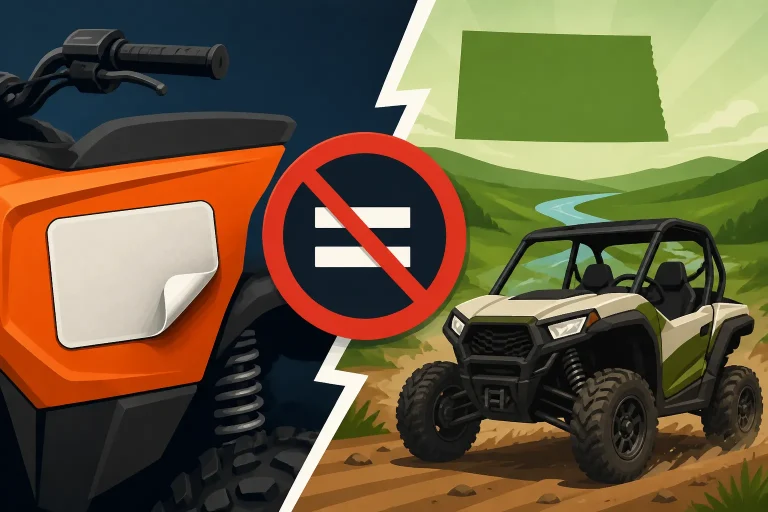
South Dakota registration does not provide North Dakota reciprocity
Reciprocity would mean North Dakota recognizes a South Dakota registration, permit or other credential as a substitute for its own requirement. For off-highway vehicles, you should not assume that recognition exists: North Dakota does not offer general reciprocity with South Dakota or other states.
In practical terms, having a South Dakota title, registration, plate or decal does not by itself satisfy North Dakota’s nonresident permit requirement. A machine that is legal to operate at home may still need a North Dakota permit before you ride it on a North Dakota public riding area where the permit applies.
That does not necessarily mean you must register the machine in North Dakota just for a short visit. Registration and the nonresident permit are separate questions. The rules for a visitor’s out-of-state registration can depend on how long the machine is in North Dakota and how it is used. The permit, meanwhile, is a North Dakota requirement for visitors riding in places covered by that permit.
| What you have or plan to do | What it does not establish | What to check |
|---|---|---|
| South Dakota registration | It does not automatically replace North Dakota’s nonresident permit | Whether the North Dakota permit is required for your intended riding area |
| A North Dakota nonresident permit | It does not make every road, trail or parcel open to riding | Land access, trail status and local restrictions |
| A machine registered in South Dakota | It does not settle every North Dakota registration question for a longer stay | The rule for out-of-state machines and the length of your stay |
| Permission from a private landowner | It does not automatically satisfy public-land permit or roadway rules | Whether the ride also uses public land, a trail or a road |
North Dakota’s visitor permit is generally the item to investigate first when you are bringing a machine from South Dakota for a ride on public land. It is not the same as changing the machine’s home-state registration, and it is not a statewide pass that grants access wherever you choose.
The distinction matters because a rider may be exempt from registering a machine in North Dakota during a temporary visit yet still need the North Dakota permit. The exemption from resident registration does not necessarily exempt a visitor from the separate riding permit. For more on that separation, see North Dakota’s 30-Day Out-of-State Rule and North Dakota’s Non-Resident OHV Permit.
Which North Dakota requirements apply to a visiting rider
Before traveling, sort the paperwork into separate categories: the machine’s registration, the visitor permit, the rider’s safety requirements and the rules for the place where you intend to ride. One document does not cover all four.
Nonresident OHV permit
North Dakota requires visiting riders to check its nonresident permit rules rather than relying on a South Dakota credential. The permit is tied to riding in North Dakota; it is not a transfer of your South Dakota registration. Requirements may differ depending on the kind of machine and where you plan to operate it, so confirm the current instructions through the official state channel before your trip.
The permit period and purchase options are details worth checking close to departure. A permit may be available through state channels, including online or at certain state park locations, but do not assume a particular sales location will be open or carry permits when you arrive. If your visit falls late in the season, also check when the permit expires. A permit’s calendar period may not match the date you bought it.
Your machine’s class can matter too. North Dakota separates OHVs into classes, and a side-by-side, ATV and tracked machine may not follow precisely the same requirements. If you are bringing a machine with tracks, ask specifically whether it needs an additional permit. Start with North Dakota’s Class I, II and III Machines if you are unsure how North Dakota classifies your vehicle.
Out-of-state registration and length of stay
A South Dakota registration may remain relevant when North Dakota determines whether a visitor must register a machine in the state. However, the visitor rule has a time boundary, and a stay that continues beyond the allowed period can change what is required. Do not interpret a temporary-visitor rule as unlimited permission to keep operating indefinitely on a South Dakota registration.
Keep a record of when the machine entered North Dakota if you expect to stay for an extended period. If you are leaving a machine at a North Dakota cabin, riding area or other property for repeated visits, check the rules for that situation rather than treating each trip as automatically separate. The details can depend on the owner’s residence, the machine’s registration and how long it remains in the state. North Dakota Visitors Staying Over 30 Days explains why a longer visit deserves a fresh check.
Also distinguish riding permission from registration status. Being properly registered in South Dakota does not make a private trail or public road open to OHVs. Likewise, buying a North Dakota permit does not necessarily resolve a registration requirement that applies because of a longer stay.
Safety certificate and rider age
A permit for the machine and a safety certificate for the rider are different things. If a young person will be riding, check North Dakota’s age-specific safety requirements before the trip. Do not assume that South Dakota’s rules, a home-state card or the age at which the rider may operate at home will automatically satisfy North Dakota requirements.
Carry any required certificate or documentation while riding. If you are uncertain whether a certificate issued in South Dakota is recognized, ask the state agency responsible for the North Dakota requirement before departure. Relevant details are covered in North Dakota OHV Safety Certificates at Age 12 and Whether a Safety Certificate From Another State Counts.
A trip with multiple riders can involve different requirements for each person. A parent may have the machine permit handled while a younger rider still needs to meet an age or training rule. Check each rider’s situation instead of treating one permit as covering everyone in the group.
A permit is not permission to ride everywhere
The North Dakota permit answers one paperwork question. You still need to confirm that the land or route is open to OHV use, and that your machine may use it.
A visitor heading to a designated OHV trail should check the trail manager’s current status, access conditions and any machine-width limits. Trails can close because of wet conditions or other management decisions. A permit does not override a closure, and a trail shown on an old map may not be open on the day you arrive. If a route has a width restriction, measure the machine as directed by the trail manager rather than relying on the model’s advertised dimensions. North Dakota Trails With Width Limits is useful if you are traveling with a wide side-by-side.
Public roads are a separate matter. The rules for a road, ditch or shoulder depend on the road surface, the route’s status and North Dakota’s operating requirements. Do not treat a visitor permit as road authorization. If your plan includes ditch riding or public roads, review North Dakota ATV Road Rules by Surface Type and check any county or city restrictions along the route. A route that is legal in one jurisdiction may be restricted in another.
Private land requires the landowner’s permission. A state permit does not grant entry, and permission to cross one parcel does not give permission to continue across adjoining property. Posted-land rules apply whether your machine is registered in South Dakota or permitted in North Dakota. If your route crosses private ground, secure permission in advance and understand where it begins and ends.
State park entry is another separate issue. An OHV permit is not necessarily the same as a vehicle entrance permit for a state park. If you are towing to a park, ask what is required for the truck and trailer as well as for the OHV. Confirm whether the riding area is managed by the park or another land manager, and whether its access rules differ from general state requirements.
A practical way to avoid mixing these rules up is to ask two questions for every stop on your trip:
- Is my machine and rider properly documented for North Dakota?
- Is this specific place or route open to this machine today?
Both answers need to be yes. A correct permit cannot fix an access problem, and an open trail does not waive a permit requirement.
How to prepare for a South Dakota to North Dakota ride
A little preparation can prevent a wasted drive or an unnecessary stop at a trailhead. Work through the trip in this order.
-
Identify the machine. Record whether it is an ATV, side-by-side, dirt bike or tracked machine. Note its width and any modifications that could affect its classification or trail eligibility.
-
Check its South Dakota paperwork. Confirm that the registration is current and that the identifying information on the machine matches the documents. Bring proof that connects you to the machine, especially if you recently bought it or the name on the registration is not the rider’s.
-
Check North Dakota’s nonresident permit instructions. Confirm whether your planned riding requires a permit, how to obtain it, the valid period and whether the machine type calls for anything additional. Do not rely on a prior year’s permit information or on what a friend bought for a different machine.
-
Review each rider’s requirements. Look at age, safety training and documentation separately from the machine’s paperwork. If a South Dakota certificate is involved, confirm that it is accepted for the North Dakota situation.
-
Confirm the location is open. Contact the trail or land manager, or check its current status information. Ask about closures, width limits, parking, staging and other access restrictions.
-
Map the route legally. If you plan to travel between a trailhead and another destination, check each road, ditch, private parcel or public-land segment. A legal trail connection should not be assumed just because it appears continuous on a map.
-
Keep documents accessible. Carry the permit and any required registration or safety documents where they can be shown during a lawful check. Keep a digital backup if practical, but do not assume a phone image will substitute for every required document.
If a machine has no current South Dakota registration, has recently changed owners or will remain in North Dakota for an extended period, ask the appropriate state office about that specific case. The answer may differ from the ordinary short-visit situation. For title or ownership questions, North Dakota Registration Versus a Non-Resident Permit helps explain why those are separate issues, while North Dakota Registration for a New Resident applies if the owner has moved to North Dakota rather than simply visiting.
A useful pre-trip check is to call or contact the relevant agency with the machine’s type, registration state, planned stay and intended riding location. Those details make the question answerable. Asking only whether South Dakota paperwork is accepted can produce an incomplete answer if the real issue is a nonresident permit, a trail closure or a longer stay.
The simplest rule for a South Dakota rider is to bring the home-state paperwork, obtain any North Dakota permit that applies, and verify access for each place on the itinerary. South Dakota registration is not a substitute for North Dakota requirements, but a visit does not automatically mean you must transfer the machine’s registration either. Keeping those questions separate makes planning clearer and helps ensure your first stop is a ride, not a paperwork detour.
Disclaimer
This article is for general informational purposes only and does not constitute professional advice. Laws, prices and regulations vary by location and change over time. Consult a qualified professional for guidance on your specific situation.