North Dakota Tree Nursery Damage Rules
There's nothing quite like the thrill of exploring North Dakota's wide-open spaces on your ATV or UTV, feeling the prairie wind against your face. But with that freedom comes a significant responsibility, especially when you find yourself riding near agricultural areas, tree nurseries, or young shelterbelts. One wrong turn or a moment of inattention can unfortunately lead to serious damage to these vital plantings, and that can come with real legal consequences. This guide will walk you through North Dakota's specific rules and considerations concerning damage to tree nurseries and other young tree plantings, helping you become a more informed and responsible rider.
Understanding What Constitutes Damage to Tree Nurseries and Shelterbelts
When we talk about tree nurseries or shelterbelts in North Dakota, we're discussing deliberate plantings that are either cultivated for sale, grown for conservation efforts, or established to protect cropland, farmsteads, and livestock from the harsh prairie winds. These trees, especially when young, are incredibly vulnerable, and any intrusion can set back years of growth and investment.
Types of Damage from OHV Activity
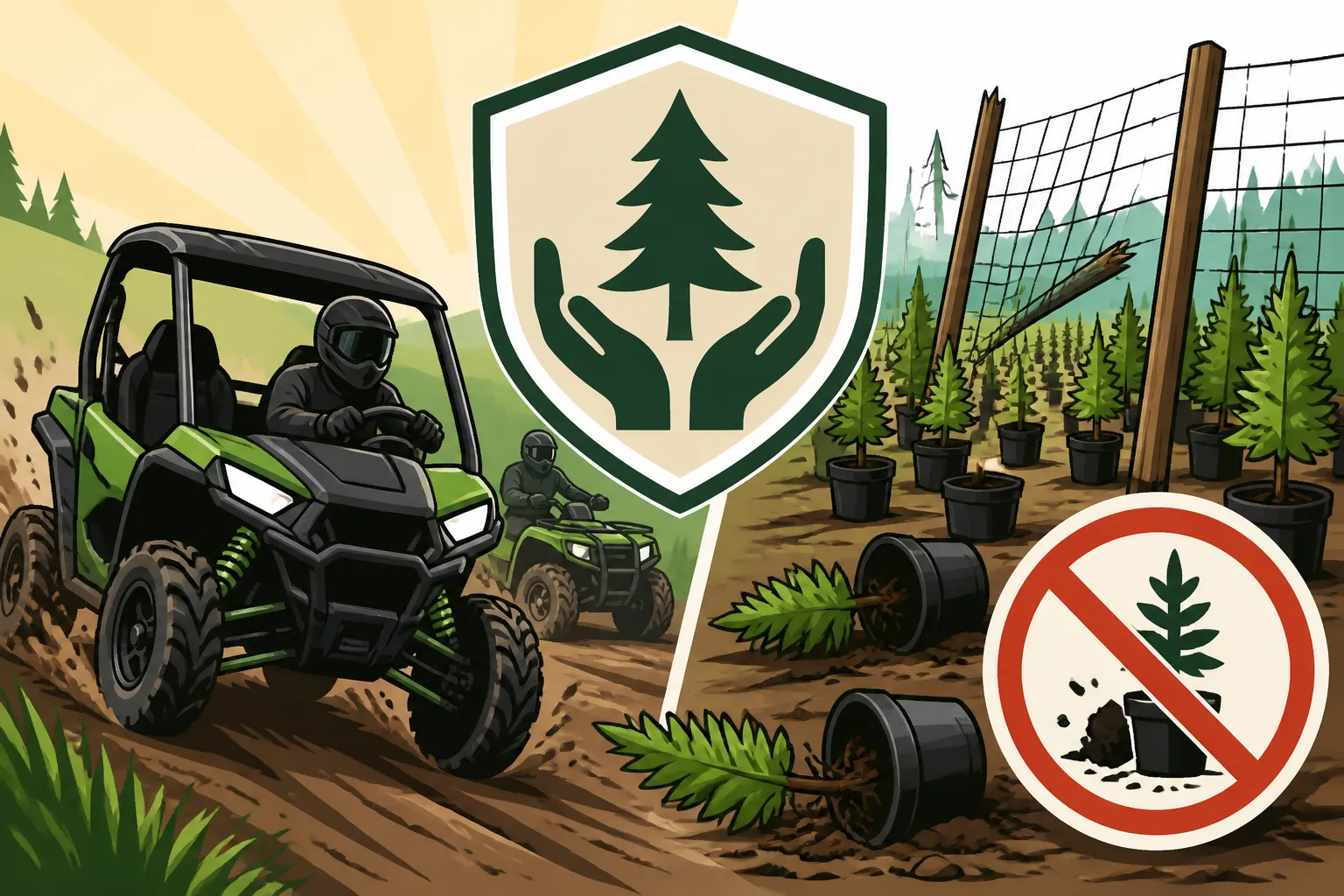
It’s not just about running directly over a sapling, although that's certainly a clear form of damage. OHVs can inflict harm in many subtle ways, often unknowingly. For instance, compacting the soil around young trees with your tires can starve their roots of oxygen and water, hindering their growth. Weaving through rows of young trees might break delicate branches, strip bark, or even uproot smaller plants. Even simply kicking up excessive dust can coat leaves, reducing their ability to photosynthesize, which is crucial for survival and growth. Think about the cumulative effect of several machines passing through an area, and the impact can be devastating.
Identifying Vulnerable Plantings
Many tree nurseries are clearly marked, often with fences or signs, indicating their agricultural purpose. Shelterbelts, on the other hand, might be less obviously defined as "off-limits," appearing simply as rows of young trees bordering a field or property line. These are often established with state or federal cost-share programs and represent a significant investment of time, money, and effort for landowners. They are not merely wild groves; they serve a specific, protective function. Recognizing these plantings, whether they're a tidy grid of saplings or a nascent windbreak along a section line, is the first step toward avoiding accidental damage. Always assume that any planted trees, particularly young ones, are part of someone's livelihood or a vital conservation project.
The Legal Consequences of Damaging Trees in North Dakota
North Dakota law takes damage to property seriously, and tree nurseries or shelterbelts are no exception. Riders often think about vehicle registration or safety gear, but understanding property damage laws is just as crucial. Trespassing onto private land, especially where active cultivation or planting is occurring, and then causing damage, can lead to more than just a stern talking-to.
Penalties for Property Damage and Trespass
If you damage a tree nursery or shelterbelt through your OHV activity, you could face charges related to criminal mischief, trespass, or both. Criminal mischief, which covers damage to property, can range from a misdemeanor to a felony depending on the extent of the damage. A few broken saplings might lead to a Class B misdemeanor, but extensive damage across many acres could escalate to a Class A misdemeanor or even a felony, especially if the financial loss is substantial.
Beyond criminal charges, landowners can also pursue civil action against you for the cost of the damaged trees, including replacement costs, labor for replanting, and even lost future income if the trees were being grown for harvest. It's not uncommon for landowners to document all damages, obtain professional appraisals for the lost value, and then seek full restitution. This can quickly add up, turning a fun afternoon ride into a very expensive lesson. Remember, your personal liability insurance might cover some of this, but it’s far better to avoid the situation entirely. For more on general penalties, consider reading [North Dakota Penalties for Riding Unregistered].
The Role of Posted Land and Signage
North Dakota's trespass laws are clear about entering private land, and postings are a key component. Landowners have the right to post their property to prohibit entry. For OHV riders, seeing "Posted" signs means "no entry" unless you have explicit permission. These signs are often a first line of defense for agricultural lands, including nurseries and shelterbelts. While not all tree plantings might be perfectly fenced or signed every 880 yards as required for some types of posting, the presence of cultivation or clear planting patterns should serve as its own warning.
Even if you don't see a sign, if you're on private land without permission, you are trespassing, and any damage you cause is subject to legal action. For a detailed look at how posting works, check out [North Dakota Posted Land Signs and Riders] and [North Dakota Posted Sign Spacing at 880 Yards]. Always respect these boundaries, whether marked by a fence, a sign, or simply the visible pattern of planted trees.
Preventative Measures for OHV Riders: Protecting Young Trees
Responsible riding isn't just about following the speed limit or wearing a helmet; it's also about respecting the land and private property. Avoiding damage to tree nurseries and shelterbelts requires a proactive approach and a mindset of environmental stewardship.
Plan Your Route and Know Your Surroundings
The best way to avoid damaging young trees is to simply not ride where they are. This sounds obvious, but it means taking the time to plan your route. Before you head out, review maps, satellite imagery, or even ask local landowners or the county extension office about known tree nursery locations or recent shelterbelt plantings. Stick to designated trails or public roads where OHV use is explicitly permitted. When riding on private land with permission, always clarify the exact boundaries and any areas that are off-limits, especially if there are plantings.
When navigating through unfamiliar territory, especially open fields or areas bordering agricultural operations, slow down and be extra vigilant. Look for rows of young trees, changes in vegetation, or signs of cultivation. A little caution goes a long way in preventing an expensive mistake. You might be accustomed to ditch riding in some areas, but even then, stay within the legal limits and be aware of adjacent fields. For insights into ditch riding, consult [North Dakota Ditch Riding: The Legal Right Explained].
Equipment and Riding Habits for Minimal Impact
Beyond route planning, your riding habits and even your equipment can play a role in prevention.
Here are a few tips:
- Mind Your Width: Side-by-sides and wider ATVs can inadvertently clip branches or sideswipe young trees, especially when making turns or riding too close to the edge of a planting. Be aware of your machine's dimensions.
- Tread Lightly: Avoid unnecessary wheel spin or aggressive maneuvers on soft ground, which can exacerbate soil compaction and erosion, harming root systems.
- Stay on Defined Paths: If you must traverse an area near plantings (with permission!), stick to existing farm access roads or field edges rather than cutting new paths through planted rows.
- Consider Protective Gear: While not for trees directly, installing protective accessories like skid plates or sturdy bumpers from brands like SuperATV can help prevent your machine from sustaining damage if you accidentally encounter small stumps or obstacles that might also indicate a planting area. It’s better to protect your machine and the ground simultaneously.
By adopting these habits, you're not just protecting trees; you're also building a reputation as a responsible rider, which can help foster positive relationships with landowners and the broader community.
Landowner Strategies for Protecting Their Tree Investments
While OHV riders bear the primary responsibility for avoiding damage, landowners also play a crucial role in protecting their tree nurseries and shelterbelts. Clear communication and visible boundaries can go a long way in preventing accidental incursions.
Clear Communication and Visible Boundaries
For landowners, the clearer the boundary, the better. This means well-maintained fences, prominent "No Trespassing" signs (as described in [North Dakota Posted Land Rules for Riders]), and even natural barriers where appropriate. If you have a particularly valuable or vulnerable planting, consider additional measures like highly visible flagging or temporary fencing during the growing season. Many landowners find that a friendly conversation with neighbors or local riding clubs about the presence of new plantings can also be very effective.
Landowners might also consider displaying information about who to contact in case of an emergency or accidental trespass. A clearly posted phone number, in addition to "No Trespassing" warnings, provides an avenue for dialogue rather than immediate confrontation, which can often lead to better outcomes.
Damage Reporting and Restitution
When damage unfortunately occurs, landowners have clear avenues for reporting it and seeking restitution. Documenting the damage thoroughly is critical, including photographs, videos, and detailed descriptions of the affected area and the estimated number and type of trees damaged. Getting an appraisal from a local nursery or agricultural expert can provide an accurate financial assessment of the loss, which is vital for any legal proceedings.
Landowners should contact local law enforcement immediately to file a report. This creates an official record and initiates the investigative process. Beyond criminal charges, civil action can be pursued to recover monetary losses. Many landowners find success by engaging with the local prosecutor or their own legal counsel to navigate these steps. Understanding what a Class B Misdemeanor means in North Dakota for property damage can help manage expectations for the legal process.
Table: Landowner Actions for Protecting Tree Plantings
| Action Category | Specific Strategies | Benefits for Landowner | Impact on OHV Riders |
|---|---|---|---|
| Boundary Delineation | Erect clear fencing around nurseries/shelterbelts. | Deters accidental entry; clear visual barrier. | Provides unambiguous "no go" zone. |
| Install prominent "No Trespassing" signs (per ND law). | Legal protection; clear warning. | Removes ambiguity; warns of legal consequences. | |
| Use brightly colored flagging tape for new/vulnerable plantings. | Highly visible, even from a distance. | Easier to spot sensitive areas quickly. | |
| Communication | Inform local sheriff/game warden of plantings/vulnerable areas. | Increases patrol awareness; quicker response. | Encourages officers to educate riders. |
| Talk to adjacent landowners and local riding groups about sensitive areas. | Fosters good relations; spreads awareness. | Educates community; builds trust. | |
| Damage Response | Photograph and document all damage immediately. | Essential for legal proof and insurance claims. | Ensures fair assessment if rider is found responsible. |
| Obtain professional appraisal for tree replacement/value. | Justifies restitution amount; strengthens case. | Transparent calculation of damages. | |
| File police report and consider civil action. | Legal recourse for property damage. | Holds irresponsible riders accountable; deters future acts. | |
| OHV-Specific Features | Consider natural barriers like large rocks or ditches on approaches. | Physically blocks casual access. | Forces riders to find legal, safe entry points. |
| Clearly mark farm access points vs. off-limits areas. | Guides authorized vehicles; discourages unauthorized. | Helps distinguish between allowed and restricted paths. |
Navigating Public and Private Lands Near Tree Plantings
The line between public access and private property can sometimes feel blurry, especially in North Dakota's vast rural areas. Understanding where you can and cannot ride, particularly near areas with tree nurseries or shelterbelts, is paramount for responsible OHV use.
The Nuances of Section Lines and Township Roads
Many riders rely on section lines and township roads for access across rural landscapes. While these generally provide public access, the land immediately adjacent to them is almost always private. This means staying within the defined right-of-way. It's a common misconception that if a section line isn't fenced, it's open season on the land next to it. That's simply not true.
Young trees, whether part of a nursery or a nascent shelterbelt, are frequently planted right up to or very near these rights-of-way. Riders must exercise extreme caution. Even pulling off to the side to check a map or take a break could inadvertently place your tires on private land, potentially compacting soil or disturbing young saplings. Always assume that the land beyond the gravel or dirt path is private unless you have explicit, written permission from the landowner. Knowing your rights and responsibilities when riding on [North Dakota Rules for Riding a Section Line] or [North Dakota Rules for Riding a Township Road] is crucial.
Obtaining Landowner Permission
The golden rule for riding on any private land, especially near sensitive agricultural operations like tree nurseries, is to get permission first. This isn't just a suggestion; it's a legal requirement. A simple conversation can often grant you access and clarity on where you can and cannot ride. It's always best to get this permission in writing, detailing the dates, areas, and any specific restrictions. This protects both you and the landowner.
Many landowners are more than happy to allow responsible riders on their property, provided they know who you are, what you'll be doing, and that you'll respect their land. Having a signed [North Dakota Landowner Permission Forms] can be invaluable if you're ever questioned by law enforcement or a curious neighbor. Never assume implied permission based on past use or an open gate; always ask. This proactive step helps foster trust and ensures a positive relationship with the agricultural community.
The Importance of Reporting Damage and Restitution
Even the most careful riders can sometimes make mistakes, or you might witness damage caused by others. Knowing how to react responsibly, especially when it involves property damage to vulnerable plantings, can make a significant difference.
What to Do If You Accidentally Cause Damage
If you accidentally cause damage to a tree nursery or shelterbelt, the absolute best thing you can do is take responsibility immediately. Do not flee the scene. This only makes matters worse and strengthens any potential criminal charges or civil claims against you.
Here's a responsible approach:
- Stop and Assess: Safely stop your machine and assess the damage.
- Locate the Landowner: If possible, try to locate the landowner immediately to report what happened. Look for nearby houses or farm buildings.
- Document: Take photos or videos of the damage and the surrounding area. Note the date, time, and your exact location.
- Exchange Information: Provide your contact information (name, phone number, address) and get the landowner's information.
- Offer to Make Amends: Express your sincere apologies and discuss how you can make it right. This might involve monetary compensation or offering to help replant.
- Contact Law Enforcement (Optional but Recommended): If the landowner is unreachable or the damage seems substantial, consider contacting the local sheriff's office yourself to report the incident. This shows good faith.
Your insurance policy might have specific provisions for property damage liability, which could help cover restitution costs. It's important to understand your [North Dakota Insurance Requirements at Registration] and what your policy covers. Being upfront and honest can significantly mitigate the legal and financial repercussions.
Witnessing Damage or Suspicious Activity
If you witness other OHV riders causing damage to tree nurseries or acting suspiciously near these sensitive areas, you also have a responsibility to act. While direct confrontation can be risky, reporting the activity to the proper authorities is crucial for protecting private property and ensuring accountability.
Here's how you can help:
- Do Not Engage Directly: Unless you feel completely safe and confident, avoid direct confrontation. People can be unpredictable, and your safety is paramount.
- Gather Information: From a safe distance, try to gather as much information as possible:
- Description of the OHVs (color, type, distinguishing features).
- License plate or decal numbers if visible.
- Description of the riders.
- Specific location of the damage or activity.
- Time and date.
- Any photos or videos you can safely capture.
- Report to Authorities: Contact the local sheriff's department or county law enforcement. Provide them with all the details you've gathered. They are the ones equipped to handle such situations.
By reporting irresponsible behavior, you're not just protecting trees; you're also safeguarding the reputation of the entire OHV riding community. Responsible riders want to see those who damage property held accountable, ensuring that access to riding areas isn't jeopardized for everyone. You might also want to review [North Dakota Trespass Law for Riders] to understand the legal framework behind such reports.
Disclaimer
This article is for general informational purposes only and does not constitute professional advice. Laws, prices and regulations vary by location and change over time. Consult a qualified professional for guidance on your specific situation.