Why a Track-Only Racer Skips North Dakota Registration
It can be incredibly confusing to figure out the exact rules for your off-highway vehicle (OHV) in North Dakota. You might have a machine specifically for racing, one that never touches public roads or trails, and wonder why it looks just like the ones your friends are registering. This guide aims to clear up the specific circumstances under which a track-only racer can bypass North Dakota's typical registration requirements, saving you time and hassle.
Understanding North Dakota's OHV Definition and Its Exclusions
When you first dive into the world of OHV ownership in North Dakota, the sheer volume of rules can feel overwhelming. You see all these machines — ATVs, UTVs, dirt bikes – and the common wisdom is that they all need to be registered and titled. For most riders who plan to explore the state's fantastic public lands, this is absolutely true.
What North Dakota Considers an OHV for Registration
North Dakota's definition of an off-highway vehicle is broad, generally encompassing any motorized vehicle designed primarily for travel on unimproved surfaces and not for use on public highways. This includes common machines like ATVs (all-terrain vehicles), UTVs (utility terrain vehicles), and dirt bikes. If you're going to take your quad out for a spin in [Pembina Gorge: North Dakota's OHV Trail Park] or even just use your side-by-side to get around your local township roads, you're almost certainly going to need to register it. The state wants to know who owns these machines and ensure they're contributing to the upkeep of the public areas they utilize. Without this clear framework, it would be much harder to manage trail systems and respond to incidents.
The general expectation is that if it has an engine and goes off-road, it needs paperwork. This leads to a lot of head-scratching for folks whose machines truly never leave a private, controlled environment. It feels like you're being asked to pay for something you're not using, which can be a real frustration. But the state's focus is on regulating vehicles that interact with the public infrastructure, public safety, and public lands.
The Specific Carve-Outs for Non-Public Land Use
Here’s where the distinction for track-only racers becomes crucial. North Dakota's registration requirements are primarily concerned with OHVs that operate on public lands, public roads, or rights-of-way. If your machine exclusively operates on private property and never, ever touches anything resembling public access, then it might fall under an exemption. This is a common point of confusion because many assume "off-highway" automatically means "needs registration." But it's more nuanced than that.
One of the most significant exemptions is for machines used solely on private land. This means if you have a sprawling ranch and use your side-by-side to check fences, or if you own a private motocross track and only ride your dirt bike there, North Dakota law typically doesn't require you to register that machine. The critical element is that the vehicle's operation is confined to land that is not open to the public, preventing any interaction with public roads, trails, or other shared spaces. This distinction helps to define the scope of regulatory oversight. For other specific scenarios, you might want to look into [North Dakota Registration Exemptions Explained] to see if your situation fits any other categories.
The "Closed Course" Exemption: What It Really Means for Racers
For those dedicated to the thrill of off-road racing, the "closed course" exemption is your golden ticket out of typical registration mandates. It's a recognition that competitive events and specialized training facilities operate under a different set of rules and responsibilities.
Defining "Closed Course" in North Dakota Law
In North Dakota, a "closed course" refers to a designated area, typically private property, specifically designed and utilized for organized competitive events, exhibitions, or training. Think of purpose-built motocross tracks, off-road racing circuits, or dedicated practice areas where access is controlled and participation is governed by event organizers or facility owners. These are not your average public trails or section lines that anyone can access. The land is often leased or owned by the racing organization or a private individual, and it's set up with safety measures, flagging, and boundaries unique to racing.
The key here is the control and intent. Unlike a public trail, which is open for general recreational use and funded partly by registration fees like the [North Dakota Off-Highway Trail Tax], a closed course typically operates with its own insurance, safety protocols, and often charges its own admission or event fees. Because these machines are not traversing public rights-of-way or designated public trail systems, they don't fall under the same regulatory umbrella that mandates registration and titling for general public use. It’s a pragmatic approach that acknowledges the distinct environment of organized racing.
Why Public Access Triggers Registration Requirements
The moment your track-only racer touches a public road, trail, or even a ditch, North Dakota's registration rules kick in. This is the absolute core reason most OHVs need to be registered: to ensure accountability and safety when they interact with public infrastructure and other users. Imagine a scenario where you decide to ride your race quad from your garage, down a county road, and then a quarter-mile to your buddy's private track. Even that short distance on a public road, despite your intention to only race on private land, would typically require your machine to be registered.
Public access immediately brings with it concerns for public safety, road wear, and proper identification in case of an accident. The state needs a way to identify the machine and its owner if there's an incident, damage, or if it's involved in illegal activity. Without registration, this becomes incredibly difficult. So, if you're ever tempted to take a shortcut on a gravel road or cross a section line to get to your private riding spot, remember that you're potentially putting yourself at risk of [North Dakota Penalties for Riding Unregistered] because you've moved from a private, controlled environment to a public, regulated one. Even briefly pulling off a trailer onto a public shoulder to unload can sometimes be construed as operating on public land, which is why extreme caution and awareness of your surroundings are paramount.
Practicalities for Track-Only Riders: Documentation and Best Practices
Just because your race machine doesn't need to be registered in North Dakota doesn't mean you can completely skip out on documentation. In fact, having robust proof of ownership and understanding transport rules is even more critical.
Proof of Ownership for a Non-Registered Machine
Even without the need for a state-issued title or registration, you absolutely need clear proof of ownership for your track-only racer. This is vital for several reasons: protecting yourself from theft, proving legitimate ownership if you ever sell it, or even just crossing state lines for a competition. A simple handwritten note won't cut it. You'll want a well-documented bill of sale from the previous owner (or from the dealer if new). This document should clearly identify the machine by its Vehicle Identification Number (VIN), make, model, year, and the full names and addresses of both the buyer and seller.
Services like LawDepot can be incredibly helpful here. They offer templates for bills of sale and other legal documents that ensure all the necessary information is included, giving you a professional and legally sound record of your purchase. This way, if you ever need to demonstrate ownership – perhaps to an insurance company, a race official, or even law enforcement if there's a question about the machine's origin – you have concrete evidence. While the state won't issue a title for an exempt machine, holding onto the original manufacturer's certificate of origin (MCO) is also a very good idea, as it's the birth certificate of your vehicle.
Transporting Your Racer to the Track
Your track-only racer may not need state registration, but the vehicle you use to haul it certainly will, and the trailer you put it on absolutely must. In North Dakota, any trailer used on public roads, regardless of what it's carrying, needs to be properly registered with the state. This means plates, lights, and proper safety chains are all a must. You can't just throw your dirt bike on a utility trailer and head down the highway without it being road-legal itself.
When transporting your OHV, always ensure it is securely tied down to prevent shifting during transit. An improperly secured machine can be a serious hazard on the road. Remember, the exemption for track-only machines applies only when they are operating on the private closed course. The journey to and from the track must involve a road-legal tow vehicle and a [Trailer Registration in North Dakota]. Never, under any circumstances, try to ride your unregistered race machine on public roads, even for a short distance to get to the track or loading area. It's a common mistake that can lead to fines and legal issues, entirely defeating the purpose of the exemption.
The Bigger Picture: Why North Dakota Has These Exemptions
These specific exemptions for track-only machines aren't arbitrary. They stem from a considered approach to regulating different types of OHV use, aiming to strike a balance between promoting enthusiasts' activities and ensuring public safety and resource management.
Balancing Enthusiast Needs and Public Safety
North Dakota's approach to OHV registration, including these exemptions, is a balancing act. On one hand, the state recognizes the value and passion of off-road enthusiasts, including those involved in competitive racing. Forcing every single racing machine to be registered, even if it never leaves a private track, would be an unnecessary burden and could stifle the sport. Organized racing venues typically have their own stringent safety rules, emergency protocols, and often carry specialized event insurance. These private regulations address many of the public safety concerns that state registration aims to mitigate on public lands.
On the other hand, public safety on shared roads and trails remains paramount. The registration system for general OHV use helps fund trail maintenance, provides identification in case of accidents or violations, and ensures a basic level of oversight. By creating these exemptions, North Dakota essentially says, "If you're operating in a controlled, private environment, you're responsible for your own safety and regulation within that space. If you're on public land, we need to ensure everyone's safety through registration." This distinction is critical to understanding the underlying philosophy of the law.
The Role of Trail Tax and Registration Fees
A significant reason general OHV registration is required in North Dakota is the collection of funds for public resources. When you pay your registration fees, a portion of that goes directly into the [North Dakota Off-Highway Trail Tax]. This dedicated tax is crucial for funding the development, maintenance, and signage of public OHV trails and riding areas across the state. It helps manage sites like those in [Turtle Mountain Riding in North Dakota] or [Riding North Dakota's 22-Mile Roughrider OHV Trail].
Since a track-only racer is, by definition, not using these public trail systems, it wouldn't make sense to levy a trail tax or general registration fee on them. The fees are designed to ensure that those who benefit from public OHV infrastructure contribute to its upkeep. It’s a "user pays" model where the funds generated directly support the resources being used. Understanding this allocation of funds helps clarify [Why Two Agencies Split One Fee] and why certain machines are exempt. If your machine is strictly for private, closed-course use, you're not drawing on those public resources, and thus, the requirement for those specific fees is lifted. This system aims to be fair to all types of OHV owners and users, acknowledging their different operational environments.
Here's a quick overview of the key differences:
| Feature | Track-Only OHV (Exempt) | Public-Land OHV (Registered) |
|---|---|---|
| Registration Required? | No | Yes |
| Primary Use Location | Private, closed course (e.g., race track) | Public trails, roads, private property |
| Trail Tax Applicable? | No | Yes, included in registration fee |
| Road Legal? | No | Potentially, with specific equipment |
| Proof of Ownership | Bill of Sale, MCO (highly recommended) | State Title, Registration Card |
| Public Road Transport | Must be trailered | Must be trailered (unless road-legal) |
| Liability Insurance | Often required by track/event organizers | Recommended for all riders, required off-property |
| LawDepot Document Help | Bill of Sale, Liability Waivers | Bill of Sale (for purchase) |
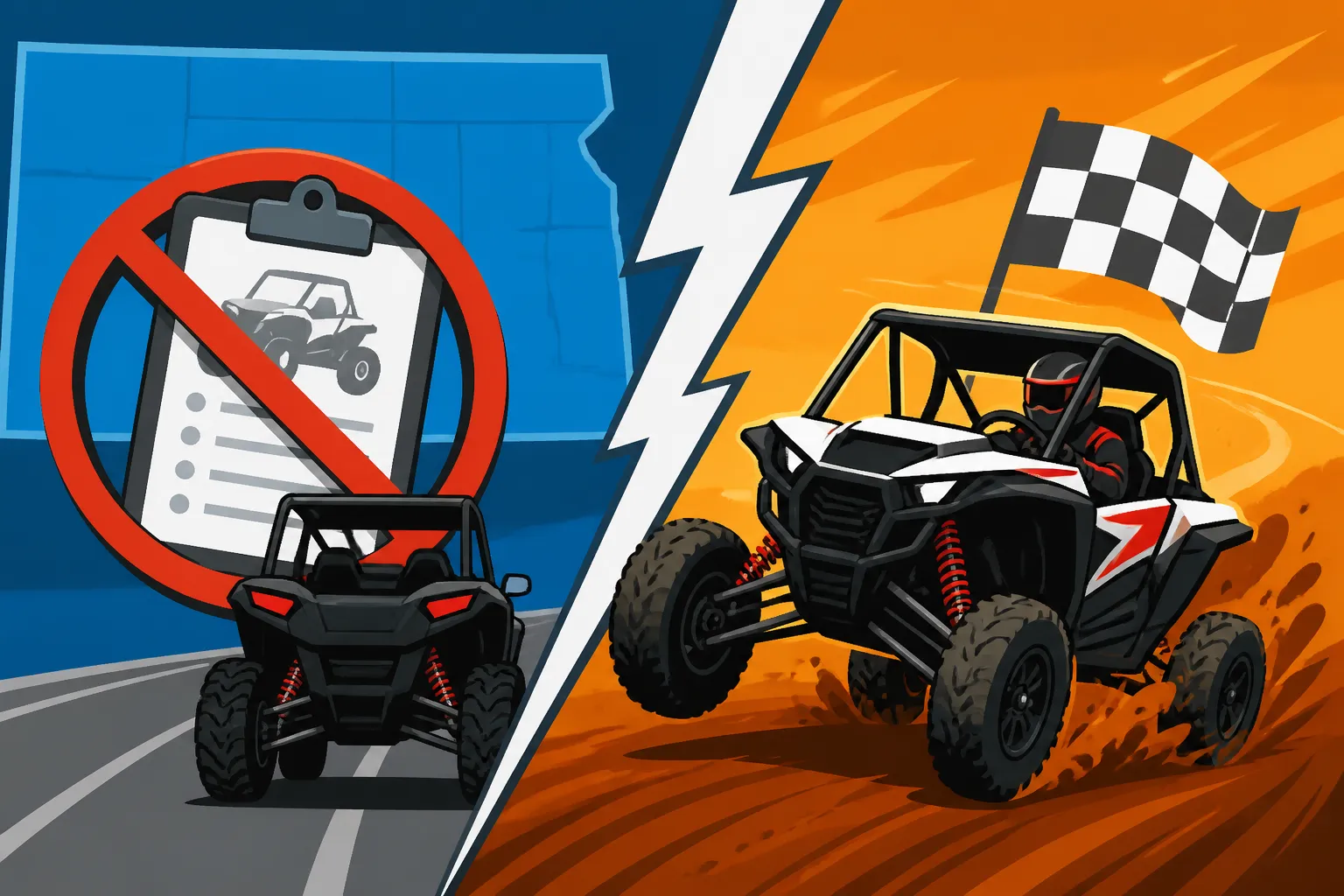
Understanding these distinctions helps clarify why a track-only racer in North Dakota isn't subject to the same registration process as a machine destined for public recreation. It's all about where and how you plan to ride.
Disclaimer
This article is for general informational purposes only and does not constitute professional advice. Laws, prices and regulations vary by location and change over time. Consult a qualified professional for guidance on your specific situation.