North Dakota Trail Etiquette Locals Expect
A North Dakota ride can go sideways quickly when dust hides the next rider, a gate is left open, or a group charges past hikers without slowing down. Good trail etiquette helps everyone enjoy the ride while protecting land, equipment, and access. This guide covers the habits locals appreciate, from sharing narrow trails to checking conditions before you unload.
Before You Ride, Learn the Ground Rules
Confirm where you can ride
North Dakota has a mix of designated OHV areas, public-land roads, and private property. A trailhead, open gate, or visible tire tracks do not automatically mean a route is open to your machine. Check the rules for the specific place you plan to ride, including seasonal closures, width limits, and restrictions on cross-country travel. A route suitable for an ATV may not be open to a wider side-by-side.
Popular places such as Pembina Gorge, the Roughrider OHV Trail, Turtle Mountain, and Kimball Bottoms each have their own setting and riding conditions. Don’t assume that a rule at one site applies at another. Before a trip, review information from the land manager and look for current notices about closures or wet conditions. [North Dakota OHV Trails: All Four Riding Areas] is a useful starting point for understanding the variety of riding areas in the state.
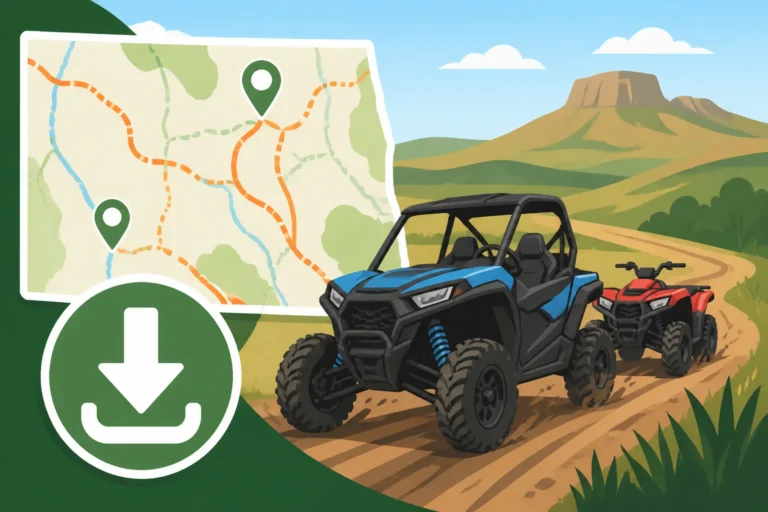
Maps can help you plan, but they aren’t permission to ride anywhere a line appears. Some riders use onX Offroad to organize routes and keep track of where they are; still, compare any app information with official maps and signs. In areas where only designated roads are open, stay on those roads instead of cutting across grassland or following an appealing track into the prairie. [North Dakota Grassland Motor Vehicle Use Maps] explains why checking the applicable map matters.
Treat access as something you help preserve
Access can depend on riders behaving responsibly. Repeated problems—such as leaving trash, damaging wet trails, ignoring signs, or riding across private land—can make landowners and managers less willing to welcome OHVs. Even if you see fresh tracks beyond a sign or barrier, don’t take that as an invitation to follow them.
Read posted signs at entrances and junctions, and pause when a route’s status is unclear. If you’re crossing or riding near private land, get permission where required and respect any conditions the owner gives you. A friendly conversation with a landowner is not a substitute for following posted restrictions. For more on the distinction between signs and permission, see [North Dakota Posted Land Rules for Riders].
When in doubt, choose a route that is clearly open rather than risking a trespass or damaging a place that may be difficult to restore. [North Dakota Cross-Country Travel Is Banned] covers an important distinction for riders planning trips on public grassland: open roads do not mean open travel across the surrounding landscape.
Share Trails With Care
Slow down, give space, and pass thoughtfully
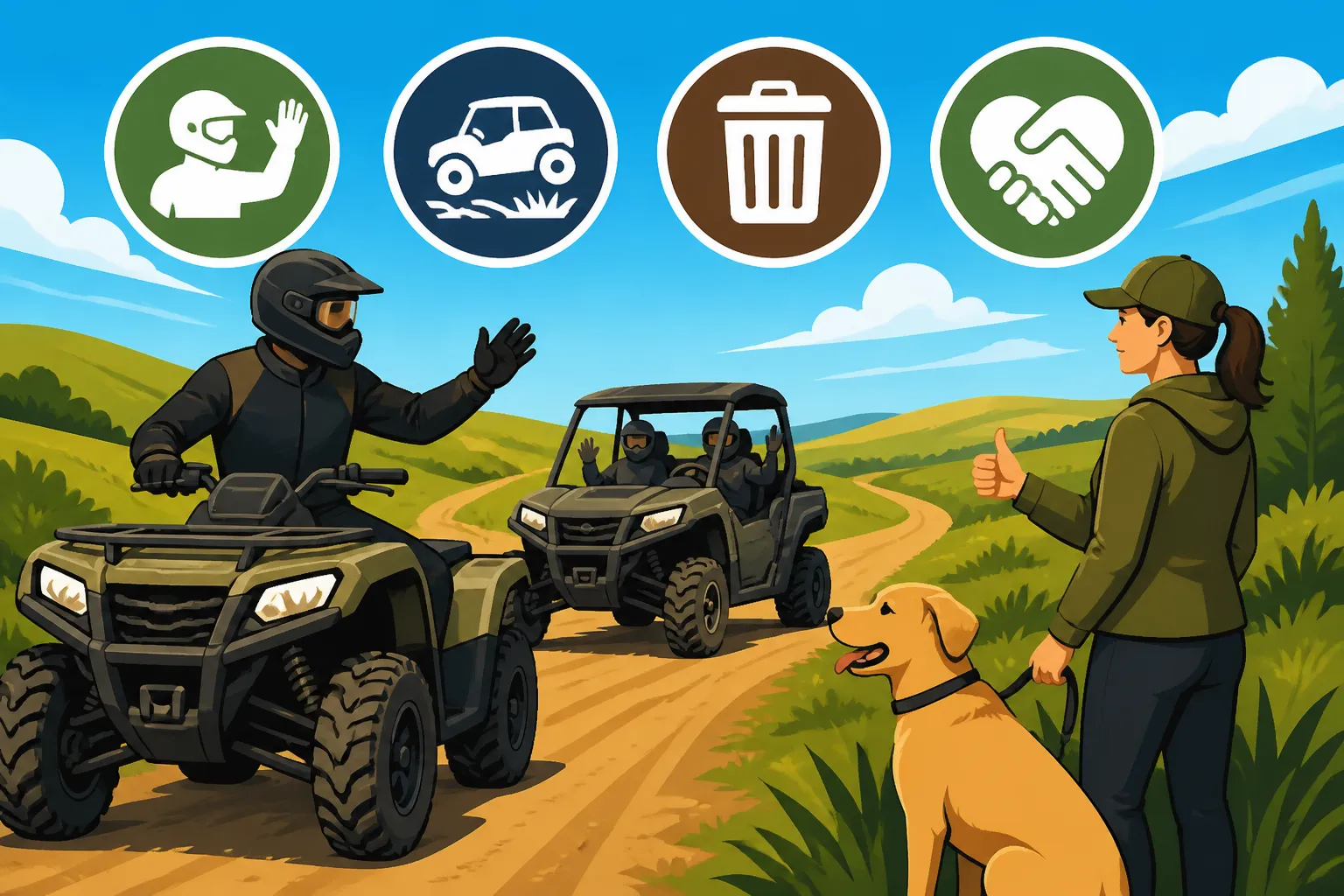
On a narrow trail, speed is less important than being predictable. Ease off the throttle when you approach another rider, a hiker, a horse, or a vehicle. Slow down far enough in advance that you aren’t throwing a cloud of dust or gravel into someone else’s face. If the trail is tight, stop in a safe spot and let the other person pass rather than squeezing by at speed.
When approaching a blind corner, hill, or trail junction, reduce speed and leave room to react. You may not be able to see an oncoming machine until it is close. Keep to the usable part of the route, watch for soft shoulders and hidden ruts, and avoid cutting a corner where another rider could be coming the other way.
Pass only when there is enough room and visibility to do it safely. Make your presence known in a calm, courteous way, then wait for the other rider to acknowledge you or move aside. Don’t crowd someone from behind, rev repeatedly, or pressure them to speed up. Once you’ve passed, give them space before returning to your usual pace.
Be especially considerate around horses and pedestrians
Horses can react unpredictably to engine noise, movement, and dust. When you see a horse, slow well before you reach it and follow the rider’s instructions. If there is no room to pass comfortably, stop and wait. Shut off the engine if asked and avoid sudden starts, sharp revs, or quick movements that could spook the animal.
The same principle applies to hikers and anyone on foot: people should not have to jump off a trail to avoid a machine. Give them time and space to move to a safe place, and don’t assume they can hear you coming. On mixed-use routes, look ahead and around bends, not just at the ground immediately in front of your tires.
At Turtle Mountain, where riders may share the area with other recreation users, a patient approach can prevent an uncomfortable encounter. The goal isn’t to win the trail or prove who has the right of way. It’s to pass without frightening anyone or creating a hazard. [Turtle Mountain Shared With Horses] offers more context for riders headed to that area.
| Situation | Courteous response |
|---|---|
| A rider approaches on a narrow trail | Slow down, leave room, and pass only when there is safe space |
| Dust is blowing toward another group | Ease off the throttle and let the dust settle before continuing |
| You encounter a horse | Stop or slow well ahead and follow the rider’s directions |
| You reach a closed or unclear route | Turn around or confirm the route is open before proceeding |
| A group is stopped near a junction | Pass slowly, avoid crowding, and keep the junction clear |
Keep group rides calm and predictable
A large group can take up more trail space than riders expect. Before setting out, agree on a pace, a meeting point, and what to do if someone falls behind. Keep enough distance between machines to see hazards and brake without running into the rider ahead. On dusty routes, that gap may need to be much larger than it would be on a clear, damp trail.
Avoid bunching up at intersections, narrow bridges, trail entrances, and parking areas. If your group needs to stop, pull completely off the route when it’s safe to do so. A line of machines blocking a junction can leave other riders guessing which direction to take or force them into soft ground to get around.
If someone in the group is new to the area, pair them with a rider who knows the route and has the map. An app such as onX Offroad can help a group keep track of its planned route, but don’t let everyone stare at a phone while moving. Stop in a safe place to check directions, then put the device away before riding again. For planning advice, see [North Dakota Group Ride Planning].
Protect Trails, Land, and Equipment
Leave the route better than you found it
Pack out everything you bring in, including food wrappers, cans, broken straps, and pieces of gear. If you spot litter that can be picked up safely, taking it with you is a small gesture that improves the area for the next visitor. Don’t leave trash at a trailhead or assume someone else will clean up after your group.
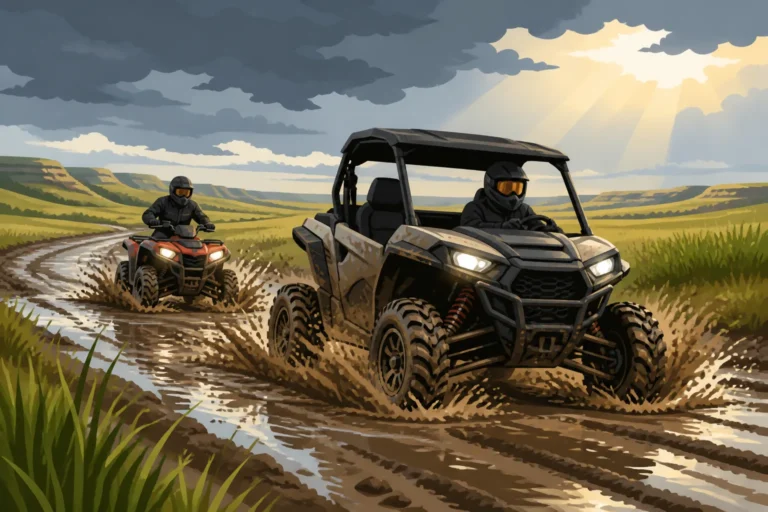
Stay on the marked route, especially where the ground is soft or vegetation is fragile. Cutting around a muddy patch can widen the trail and create a new track that other riders may follow. At places with clay or gumbo soil, a short detour can leave ruts that remain long after the ride. If the trail is wet enough that your tires are digging in, turn back rather than trying to power through.
Respect gates and livestock. If you open a gate to pass through, close it exactly as you found it unless the landowner or sign says otherwise. Ride slowly near cattle and avoid chasing, crowding, or startling animals. A gate left open can create problems well beyond your ride, especially if livestock wander onto a road or into another area.
Weather changes the right decision. Rain can make a route vulnerable to damage, while strong wind, dust, or blowing snow can sharply reduce visibility. Check conditions before leaving and be willing to change plans. [North Dakota Trails Closed by Wet Weather] and [Tread Lightly on Wet Clay] are relevant reads when a ride has to be adjusted for the ground.
Keep noise and riding behavior under control
A noisy machine can carry a long way across open country, particularly when the wind is low. Use a properly maintained muffler and avoid unnecessary revving at the trailhead, near homes, or beside other riders. Don’t make repeated high-speed passes through the same spot just because it’s convenient for your group.
Ride at a speed that fits the surface and visibility, not just the machine’s capability. Slow down near parking areas, trailheads, other people, and blind corners. Keep both hands and attention on operating the vehicle. Stopping to check a route is safer than looking down at your phone while moving.
Alcohol and impaired riding don’t mix. A trail can have hidden ruts, loose sand, steep edges, or unexpected traffic, and impaired judgment makes all of those hazards harder to handle. If anyone in your party has been drinking or is too tired to ride carefully, make a different plan. [North Dakota DUI Rules for OHV Riders] and [North Dakota Noise Complaints About Quads] cover related issues that can affect riders and neighbors.
Give closures and trail conditions real weight
A closed trail is not an invitation to find a way around a barrier. Closures may protect riders from hazards, give the ground time to recover, or keep traffic away from sensitive areas. Even if the route looks passable, riding around a closure can create damage or make it harder for managers to reopen the route.
Use official trail updates when available, and check again before you travel. A route that was open on a previous trip may be muddy, flooded, or otherwise restricted now. If you use onX Offroad to note a route or save a planned track, treat that plan as a guide—not proof that the trail is open. Follow posted signs and land-manager instructions over an old saved route or a line on a screen.
If you encounter a damaged section, don’t make it worse by repeatedly attempting to cross it. Turn around where there is room, avoid blocking the route, and report a hazard through the appropriate land manager’s channel when practical. For site-specific planning, [Pembina Gorge: North Dakota's OHV Trail Park] and [Roughrider OHV Trail's 22 Miles Along the Missouri River] can help you learn about two distinct riding destinations before you go.
Make Courtesy Part of Your Ride Plan
Set expectations before unloading
The easiest way to avoid friction is to talk through the basics before the machines leave the trailer. Decide who is leading, who is sweeping at the back, how often the group will stop, and what to do if someone gets separated. Make sure every rider knows the intended route and understands that the group will slow down for other trail users.
Do a quick check of the machine and gear before heading out. Loose cargo can fall onto the trail, a poorly secured strap can become a hazard, and a mechanical problem can turn into a long delay for everyone. Bring water, basic tools, and a communication plan that fits the area. In places where cell service may be limited, don’t assume a phone call will solve every problem.
If you’re bringing children or inexperienced riders, choose a route and pace that match their comfort and skills. Explain how to stop, where to wait, and why they should not ride ahead around a blind corner. A calm, manageable ride is more enjoyable than trying to keep up with experienced adults on a route that feels overwhelming.
Handle mistakes with patience
Even careful riders occasionally miss a turn, misjudge a muddy patch, or arrive at a busy trailhead at the same time as another group. A calm response helps. Give other riders room to sort things out, and avoid turning a simple misunderstanding into an argument. If someone asks you to slow down or wait while they move a horse or vehicle, cooperate.
If your group creates a problem—such as blocking a junction or leaving a gate open—correct it promptly. Move clear of the route, close the gate, pick up the dropped item, or turn around at the next safe point. Small corrections matter because they show respect for the people who share and care for the area.
Local etiquette is ultimately about leaving other people, land, and trails in good shape. Ride at a pace that suits the conditions, follow the route that is actually open, and give others the kind of space you would want for yourself. Those habits make a North Dakota ride safer and help keep access welcoming for the next group.
Disclaimer
This article is for general informational purposes only and does not constitute professional advice. Laws, prices and regulations vary by location and change over time. Consult a qualified professional for guidance on your specific situation.