North Dakota Trails Near Grand Forks
If you’re based in Grand Forks, finding a legal place to ride can take more planning than loading the ATV or UTV and heading out. The Red River Valley has few nearby designated off-highway trails, so this guide compares the most practical regional options, explains what to check before you go, and helps you plan a ride without mistaking ordinary roads or public land for open OHV routes.
Where to ride an ATV or UTV near Grand Forks
Pembina Gorge is the closest major trail destination
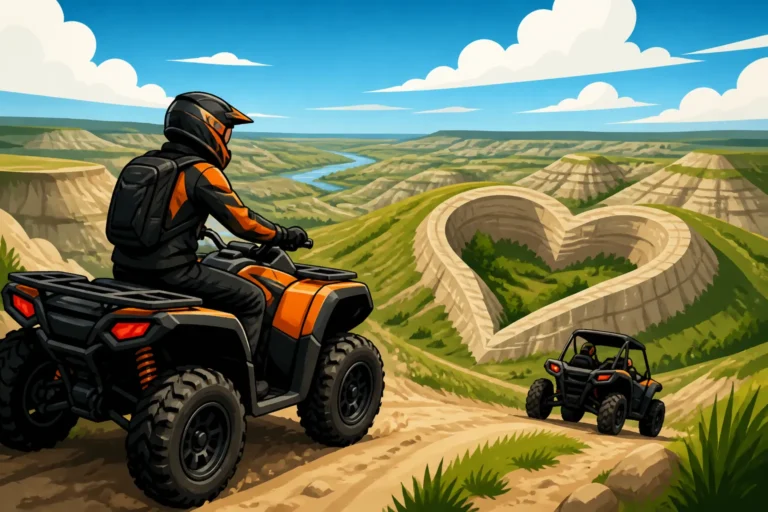
For many Grand Forks riders, Pembina Gorge near Walhalla is the most practical designated trail area to investigate first. It is north of the city, in the scenic Pembina River region, and offers purpose-built riding routes rather than an informal network of roads. Expect a drive and make a day of it, especially if you’re bringing a trailer, riding with children, or hoping to spend several hours on the trails.
The gorge’s terrain feels different from the flat farm country around Grand Forks. The routes wind through wooded slopes and rolling ground, so a ride may be more varied than the open, straight stretches you see in the valley. That variety is part of the appeal, but it also means you should match the route to your group’s experience and your machine’s capabilities. A novice rider who is comfortable on level ground may find a twisting, uneven trail more demanding.
Check trail access, conditions, and vehicle restrictions before you leave. A route that appears close on a map may not be suitable for every UTV, and muddy conditions can make riding unpleasant or damaging. For background on the area, see [Pembina Gorge: North Dakota's OHV Trail Park] and [Pembina Gorge's 16 Miles in North Dakota]. For a closer look at riding options, [Lady Slipper Loop and Who It Suits] can help you think about which kind of outing fits your group.
Turtle Mountain is a farther option for a longer trip
Turtle Mountain, near Bottineau, is another established riding destination, but it generally makes more sense as a longer day trip or overnight outing from Grand Forks. The region’s wooded terrain and riding areas offer a change of scenery from the Red River Valley. Before committing to the drive, look into the available riding areas, access points, and any restrictions that apply to the machine you plan to bring.
Getting there is only part of the planning. A large group may need to coordinate separate vehicles and trailers, while riders with limited daylight may prefer to stay nearby rather than rush back after a full day on the trails. Check where you can park, whether the route and staging area suit your trailer, and what services are available in the surrounding communities. A little preparation can prevent the frustrating experience of arriving ready to ride and discovering that your group has not agreed on a meeting point or route.
For area-specific planning, see [Turtle Mountain Riding in North Dakota] and [Finding the Sjule Road Entrance to Turtle Mountain]. If you’re comparing destinations rather than choosing immediately, [North Dakota OHV Trails: All Four Riding Areas] offers useful context about how the state’s main riding areas differ.
| Riding option | How it fits a Grand Forks trip | What to plan for |
|---|---|---|
| Pembina Gorge near Walhalla | Often the most practical major trail destination to consider from Grand Forks | Trail status, vehicle restrictions, route choice, and a full-day schedule |
| Turtle Mountain near Bottineau | Better suited to a longer day trip or an overnight plan | Drive time, staging and parking, group coordination, and local access details |
| Informal roads or nearby open land | Not a substitute for a designated OHV trail | Confirm that the specific route is open and that you have permission where required |
Don’t confuse nearby scenery with a legal riding route
A map can make a stretch of countryside look inviting, but an ordinary road, field edge, ditch, or public parcel is not automatically open to ATVs and UTVs. Land ownership and route rules matter, and access can change from one road or property to the next. If a route is not clearly designated for OHV use, verify the rules before riding instead of relying on tire tracks or another rider’s assumption.
That distinction is especially important around agricultural land. A field approach, shelterbelt, or trail across private property may look like a convenient connection, but it does not grant permission to cross. Respect posted boundaries and ask the landowner before entering private ground. For a broader look at the state’s designated options, [North Dakota Grassland Roads Open to OHVs] explains why approved roads and open cross-country travel are not the same thing.
How to choose the right ride for your group
Match the route to the machine and the riders
Before choosing a destination, think beyond the vehicle’s advertised size or power. Consider who will be driving, whether anyone is new to off-road riding, how comfortable the group is with uneven terrain, and how much time you have. A family outing with younger riders may call for a more manageable route and frequent breaks. Experienced adults on capable machines may want a longer day, but should still check the posted restrictions for the specific trail.
For UTV owners, width is an important part of the decision. A machine that fits on one trail may not fit through another trail’s access point or gate. Don’t assume that a route open to ATVs is automatically open to every side-by-side. Check the destination’s current rules and the machine’s actual width, including any accessories that could affect clearance. [North Dakota's 60-Inch Trail Width Cap] is a useful reminder to check dimensions before you tow.
Also make sure everyone understands how the group will ride together. Agree on a meeting point, a pace, and what to do if riders become separated. If one person is towing a larger UTV while another brings a youth ATV, plan around the least experienced rider rather than letting the fastest machine set the day’s pace.
Check trail status and weather before you travel
A trail plan can change quickly when conditions are wet. Mud may make a route harder to manage, and riding when trails are saturated can leave deep ruts or damage the surface. If rain is in the forecast or the area has recently had heavy precipitation, check for closures and consider postponing. A long drive from Grand Forks makes this check particularly worthwhile; it’s much easier to adjust your plans at home than after you’ve reached the trailhead.
Look for information from the managing agency or trail area before setting out. Confirm that the trail is open, that your intended entrance is available, and that no temporary restriction affects your vehicle. Trail maps and apps can help with orientation, but they do not replace posted rules or an official closure notice. You can use a mapping tool such as onX Offroad as one planning aid, then confirm access and conditions with the land manager.
Pack for North Dakota’s changeable outdoor conditions, not just the temperature in town when you leave. Wind, rain, dust, and fading daylight can all affect comfort and visibility. Bring water, basic first aid, a phone or navigation device, and a plan for getting back to the trailer. If coverage is unreliable in your chosen area, download maps or save key directions before you drive.
Compare a quick outing with an overnight trip
A day ride may work well when the destination is within comfortable driving distance and your group can arrive early enough to enjoy the trails without rushing. Build in time for unloading, safety checks, breaks, and loading up again. The ride itself is only part of the day; trailer parking and travel between Grand Forks and the trailhead also take time.
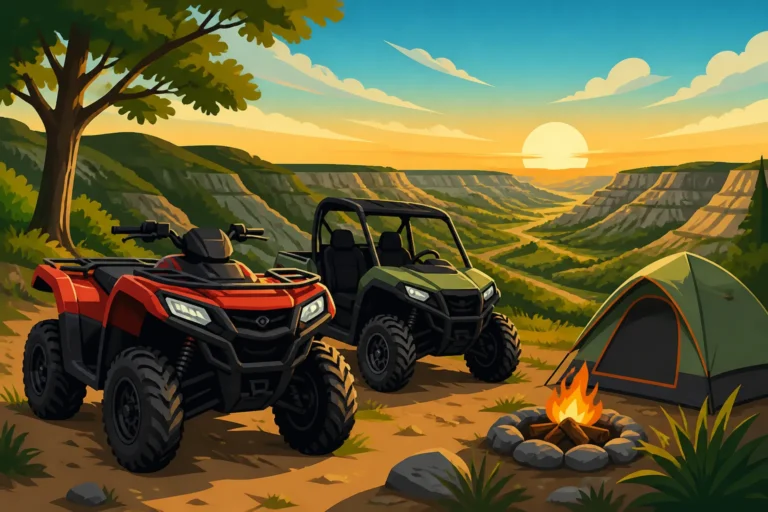
An overnight trip can make sense when you’re heading farther from home or want to ride at a relaxed pace. It gives the group more flexibility if the weather changes or a machine needs attention. It also means arranging lodging or a campsite, checking where trailers can be parked, and confirming any separate requirements for the place you stay. Trail access and campground access are different questions, so don’t assume that a camping reservation includes permission to ride everywhere nearby.
Rules and preparation for riding near Grand Forks
Confirm registration, permits, and access requirements
Before loading up, make sure your machine’s paperwork fits the trip. North Dakota registration requirements can depend on the type of vehicle and its use, while visitors may need to check separate permit rules. A state park entrance permit, when required for a vehicle entering a park, is not necessarily the same as authorization to operate an OHV on a trail. Check the specific rules for both the riding area and the machine.
If you’re not sure whether a vehicle needs registration, start with [Do You Need to Register an ATV in North Dakota?]. Riders visiting from another state can review [North Dakota's Non-Resident OHV Permit] and [North Dakota Has No Reciprocity With Any State]. These topics are especially useful if your machine is registered at home but you plan to ride in North Dakota.
Keep your paperwork easy to reach, and make sure everyone knows which documents are with the driver or stored in the vehicle. If you’re traveling with multiple machines, check each one rather than assuming the same paperwork applies to every ATV and UTV. A quick check before departure is easier than sorting out a missing document at the trailhead.
Treat road riding and trail riding as separate questions
A machine that is properly registered is not automatically allowed on every road, shoulder, ditch, or trail. Road use has its own rules, and the legal answer can vary with the type of roadway and the machine. Don’t use a public road as a shortcut to connect two riding areas unless you’ve confirmed that the route is allowed for your vehicle.
This is a common source of confusion for visitors and newer riders. A trail map may show a nearby road, but that does not mean the road is part of the OHV route. Likewise, seeing another ATV on a road doesn’t prove that the machine or rider meets the requirements. Review [North Dakota ATV Road Rules by Surface Type] before planning any road segment, and check local restrictions for the place you intend to ride.
If your trip involves a town, trailhead, or public roadway, plan how the machine will get there legally. In many cases, towing the ATV or UTV to the designated riding area is the simplest way to avoid accidentally riding where access is restricted.
Prepare the machine and trailer before leaving town
A little maintenance can save a long, aggravating day. Check tires, brakes, lights, fuel, and the general condition of each machine. For a UTV, look over the belt and any equipment you’ll rely on during the ride. Bring basic recovery and repair supplies suited to the machines and terrain, and make sure the towing vehicle and trailer are ready for the journey.
Secure machines carefully, especially if you’re hauling more than one. Check tie-downs before driving and again after the first stretch of road. Pack helmets and other protective gear where they can be reached easily rather than buried under riding bags. If children are riding, confirm their equipment fits and that the machine is appropriate for them.
Finally, agree on a simple plan for the day: who is leading, where the group will stop, and when you’ll turn back. That plan matters even on a familiar trail. A rider who takes a wrong turn, a sudden change in weather, or a minor mechanical problem is much easier to handle when the group knows where to regroup and has enough time and supplies to respond.
A practical planning checklist for Grand Forks riders
Before you leave
Choose a designated riding area and confirm that it is open to your type of machine. Review route and width restrictions, check access and parking details, and make sure your registration or permit needs are covered. If weather has been wet, look for trail-condition updates before making the drive.
Use a map to understand the route, but don’t treat a line on a screen as proof that riding is allowed. onX Offroad can help you organize navigation and saved routes; still, confirm trail access with the managing agency and follow signs on the ground. Share your destination and expected return time with someone who is not on the ride.
At the trailhead
Read signs before unloading or setting off. Confirm that your group is using the correct staging area and that every machine meets the posted restrictions. Keep speeds controlled around other riders, yield appropriately, and avoid widening the trail to pass or turn around.
If conditions look different from what you expected, reassess instead of pressing on. A wet section, damaged route, or confusing junction is a good reason to pause and check your map. Turning back can be frustrating after a drive, but it is better than damaging the trail, getting stuck, or riding into an area where access is unclear.
On the way home
Inspect machines and tie-downs before pulling away from the trailhead. Brush off mud where practical, secure loose equipment, and take a moment to note any maintenance the machines will need before the next ride. If you found a closure or a confusing access point, check with the trail manager rather than relying on word of mouth when you plan your next visit.
For Grand Forks riders, the main takeaway is straightforward: start with a designated area such as Pembina Gorge, consider Turtle Mountain when you have time for a longer trip, and verify rules and conditions before towing. A little research makes the ride safer, more enjoyable, and far less likely to end with an avoidable access problem.
Disclaimer
This article is for general informational purposes only and does not constitute professional advice. Laws, prices and regulations vary by location and change over time. Consult a qualified professional for guidance on your specific situation.