Insurance a Landowner May Ask About
A landowner in North Dakota may ask for proof of insurance before allowing an ATV or UTV onto private property. That request is not the same as a statewide insurance rule, and a registration decal or visitor permit is not proof of coverage. The practical step is to confirm what the landowner needs, then ask your insurer whether your policy actually meets it.
Why a landowner may ask for insurance
Private-land permission and insurance serve different purposes. Permission answers whether you may ride on a particular property. Insurance may help pay covered costs if your riding injures someone or damages property. One does not replace the other: being insured does not give you permission to ride, and having permission does not guarantee that a loss is insured.
A landowner may want to reduce the chance of being left to handle an accident-related claim alone. A rider could collide with a person, a vehicle, a fence, livestock equipment, or another structure. Even when the rider believes the landowner is not at fault, an incident can lead to demands for payment or a legal claim. The owner may therefore set insurance as a condition of access, especially for organized rides, repeated visits, or use of a large property.
A landowner’s request does not automatically mean every ATV or UTV rider in North Dakota must carry the same coverage in every situation. Legal requirements can depend on where and how a machine is operated. Rules for public roads, public riding areas, private property, and organized events are not necessarily identical. Check the applicable requirements for the specific place and activity rather than treating a landowner’s request as a summary of state law. For a broader overview, see North Dakota ATV Insurance Requirements.
When riding on someone else’s land, the owner may also have concerns that a basic policy does not address. For example, a policy might cover certain injuries to other people but exclude damage to the land, livestock, or property in your care. Coverage can also differ between a privately owned machine, a rented machine, and a machine used for work. The word “insured” is not enough to tell you what a policy will pay for.
If an owner asks for coverage, treat the request as part of the access agreement. Get the details before you unload. For guidance on the permission side, see North Dakota Posted Land Permission and North Dakota Landowner Permission Forms.
What to clarify before you ride
Ask the landowner to describe the insurance requirement in plain terms. A short conversation can prevent a disagreement at the gate or confusion after an incident.
Find out:
- Whether the owner wants proof of liability coverage, a particular policy document, or another form of confirmation.
- Whether the request applies to every rider in your group or only the person who owns the machine.
- Whether each ATV or UTV needs to be identified on the policy.
- Whether the owner has asked for a particular coverage limit or policy wording.
- Whether the request applies to guests, children, passengers, and any person operating a borrowed machine.
- Whether the owner expects coverage for property damage, injuries, or both.
- Whether riding for a club event, work task, or other organized activity changes the requirements.
A verbal request such as “bring proof of insurance” can mean different things. One owner may be satisfied with an insurance card. Another may want a document from the insurer showing the type of coverage and effective dates. If the landowner asks to be named on a policy or requests particular wording, do not assume that an ordinary insurance card meets the request. Ask your insurer whether it can provide what the owner wants and whether doing so changes your coverage or obligations.
| What the landowner asks for | What to clarify | Why it matters |
|---|---|---|
| Proof of insurance | Which document is acceptable and whose policy must show coverage | A card may not list every machine or explain coverage details |
| Liability coverage | Whether the request concerns injury, property damage, or both | Policies can treat these losses differently |
| Coverage for each machine | Whether the ATV or UTV must be specifically listed | Coverage can depend on the machine and how it is used |
| A particular limit | The exact limit and whether it applies per person, per incident, or in another way | A general request for “enough insurance” is hard to verify |
| Additional insured status or special wording | Whether the insurer can provide it and what it means | A certificate or card does not necessarily change who is insured |
| Coverage for an organized ride | Whether the event needs separate insurance or paperwork | A personal policy may not cover event-related activities |
The owner may also ask for a signed release or a written permission form. Those documents are separate from insurance. Read them before signing, make sure the permitted area and dates are clear, and keep a copy with your ride paperwork. A release does not prove that a policy covers you, and an insurance document does not grant access to land.
For a group ride, settle these questions with the organizer before asking the owner for access. Decide who is responsible for collecting documents, confirming that each participant has permission, and communicating any limits on where machines may travel. Keep the group within the authorized area and follow the landowner’s instructions about gates, livestock, speed, parking, and routes. Liability on Someone Else’s Land covers the separate question of potential responsibility when riding on another person’s property.
How to check your policy
Start with the insurer or agent that handles the ATV or UTV policy. Describe the actual use, not just the machine. Explain that you plan to ride on someone else’s private land in North Dakota, whether the ride is casual or organized, whether passengers will ride, and whether you will use the machine for work. Ask the insurer to confirm how the policy applies to that situation.
Useful questions include:
- Does the policy cover liability for injuries to other people while the machine is being operated on private property?
- Does it cover damage to property, and are fences, buildings, livestock, or other property subject to exclusions or limits?
- Does coverage apply to every machine and every listed operator in the group?
- Are borrowed machines, passengers, or riders who are not named on the policy covered?
- Does the policy treat farm, business, rental, racing, or organized-event use differently?
- What document can the insurer provide to show the landowner that coverage is in force?
- Can the insurer meet any special requirement the landowner has requested?
- What should you do if the machine is used both on private land and on public roads or riding areas?
Ask the insurer to explain terms you do not recognize. “Liability” generally refers to claims that you are responsible for injury or damage to someone else, but the policy controls what is actually covered. It is different from collision coverage for damage to your own machine, and different again from coverage for theft or other losses. A policy may have exclusions, conditions, or limits that matter for a particular ride. Liability Coverage Off Your Own Land and Minimum Limits a Rider Should Carry can help frame the questions, but the insurer must confirm how your own policy works.
Do not assume that a homeowner’s policy or umbrella policy automatically covers an ATV or UTV. Some policies may exclude motorized recreational vehicles or cover them only in limited circumstances. Ask the insurer that issued each policy to check the wording and explain whether the policies work together. If you are relying on coverage through a club, employer, event organizer, or rental company, request written confirmation of who and what is covered, and whether the coverage applies to your planned ride.
A certificate or insurance card is useful evidence that a policy exists, but it may not show every exclusion or settle a coverage question. If an owner wants a document that adds them to a policy, ask your insurer whether that is available and what it does. Do not edit a document yourself or promise coverage that the insurer has not confirmed.
Keep permission, permits, and insurance separate
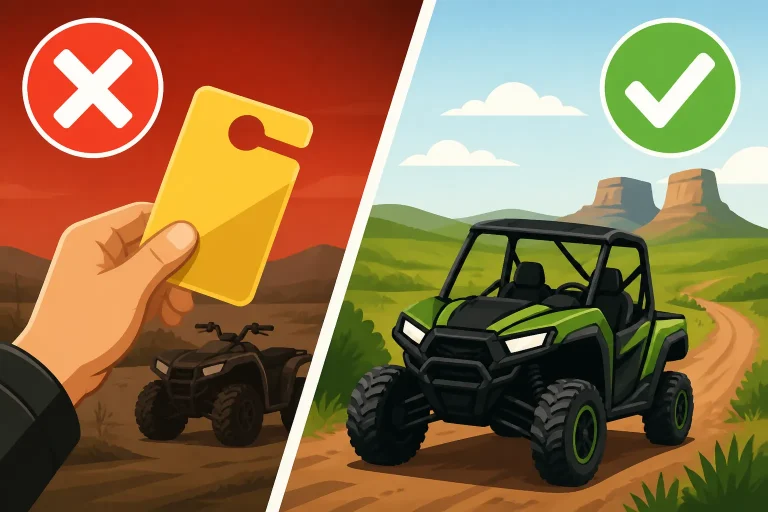
A ride can involve several kinds of paperwork, each with a different purpose. Registration identifies a machine under the applicable registration system. A nonresident permit may be needed for a visiting rider or machine in certain circumstances. Insurance concerns covered financial losses. Landowner permission controls access to private land. Carrying one document does not substitute for the others.
That distinction matters for visitors. A rider coming from another state should check North Dakota’s requirements for the machine and the intended riding location instead of assuming a home-state registration or sticker settles every question. Start with North Dakota’s Non-Resident OHV Permit and North Dakota Registration Versus a Non-Resident Permit. The permit question and the landowner’s insurance request should be handled separately.
Before heading out, use a simple check:
- Confirm that the landowner has given permission for your machine, route, dates, and group.
- Ask what insurance evidence or policy terms the owner requires.
- Confirm the policy details with your insurer, including the machine, operators, and intended use.
- Carry the accepted proof in a form you can access during the ride.
- Check registration or permit requirements for the machine and riding location.
- Tell every rider about property boundaries, closed areas, and any conditions of access.
If the landowner’s requirement seems unclear or different from what your insurer can provide, pause and resolve it before riding. The owner may be willing to clarify or adjust the request, but you should not assume that a casual assurance at the trail entrance changes the agreement. If you cannot confirm that the requested coverage is in place, the safer choice is to postpone or ride somewhere you are authorized to go under terms you can meet.
Keep copies of written permission, insurance confirmation, and relevant machine paperwork together. Store them where the group can reach them, but avoid sharing personal policy information beyond what the landowner reasonably needs. If the property owner changes the allowed route or conditions, make sure all riders hear about the change before they continue.
The key is to treat the request as a property-access condition, not as a substitute for checking North Dakota rules or reading your policy. Confirm what the owner wants, verify it with the insurer, and keep permission, permits, registration, and coverage documents distinct.
Disclaimer
This article is for general informational purposes only and does not constitute professional advice. Laws, prices and regulations vary by location and change over time. Consult a qualified professional for guidance on your specific situation.