Taking the Course From Home
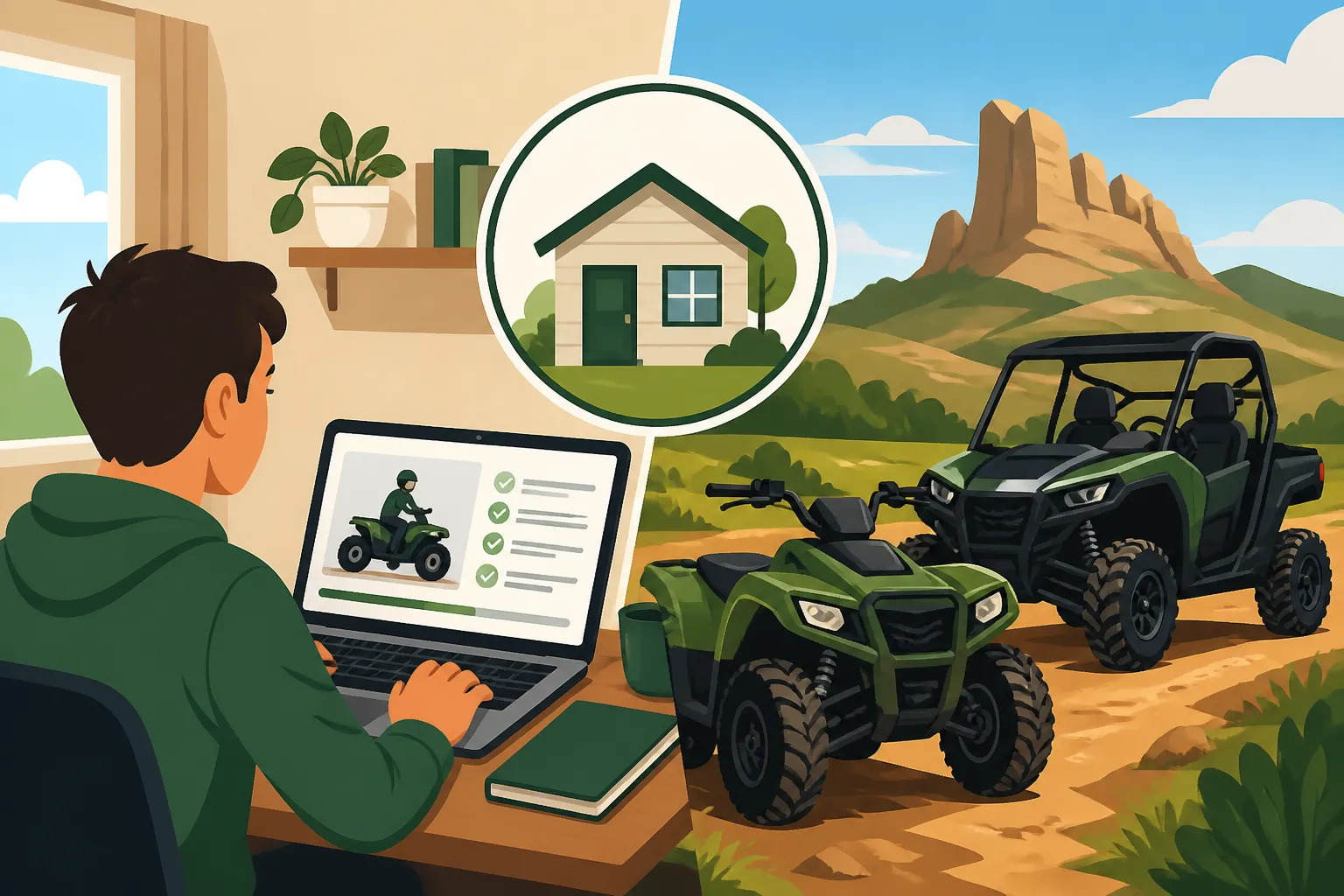
Taking the OHV safety course from home can be a convenient way for a young North Dakota rider to complete certification, but there are two different paths: a fully online course and an online introduction followed by an in-person class. Knowing which one you need helps you avoid showing up without the required certificate number or expecting an online lesson to include hands-on training.
Choose the right route before you start
The first question is whether you need full online certification or are preparing for a hands-on class. The North Dakota Parks and Recreation Department offers both options, but they are not interchangeable parts of the same process.
The complete online OHV safety course is the home-based route for riders seeking certification without attending a department hands-on session. The course costs $34.95, according to the North Dakota Parks and Recreation Department as of November 2026. Check the department’s current course instructions before enrolling, since the course provider’s steps and completion requirements are the ones you must follow.
The other route begins online but is not completed at home. Students who plan to attend a hands-on class must finish the introductory e-course before the in-person session and bring their certificate number, according to the North Dakota Parks and Recreation Department. Completing that introductory section alone does not replace the rest of the hands-on course.
| Route | What you do | What to check |
|---|---|---|
| Complete online course | Complete the full OHV safety certification course online | Confirm the course is the full certification option and follow its directions for completion records |
| Hands-on class | Complete the introductory e-course, then attend the in-person session | Bring the certificate number and arrive with the required clothing and eye protection |
| Not sure which applies | Check the North Dakota Parks and Recreation Department’s youth and course guidance | Confirm the requirement for the rider’s age, license status, and where they will operate |
A common source of confusion is the phrase “online course.” It may describe the entire certification course, or only the required introduction for an in-person class. Before beginning, check the course page for clear wording that identifies the full online option. If the rider is enrolled in a scheduled hands-on session, follow that session’s instructions rather than assuming the introductory e-course is the finish line.
For a closer look at who must be certified, see North Dakota OHV Safety Certificates at Age 12 and North Dakota Riders Under 16. The age and license details matter: a course can be useful even when it is not legally required for a particular rider, but completing it does not by itself make every kind of riding lawful.
Who needs certification and what it allows
North Dakota’s safety certification requirement is aimed at young riders who do not have a valid driver’s license or learner’s permit. The North Dakota Parks and Recreation Department says youth ages 12 through 15 without either must take a safety certification class to legally operate OHVs on allowed public lands. The department also states that OHV safety certification is required for youth to operate on land other than a parent’s, including designated trails and ditches.
The requirement is about where and how the machine is operated, not just whether the rider owns an ATV, UTV, or dirt bike. Certification is not a substitute for registration or a permit. The North Dakota Parks and Recreation Department says OHVs operated on public land generally must be registered, and all riders must be properly registered or permitted to ride legally. Review North Dakota Permits for Visiting Riders if the machine is registered outside North Dakota, and North Dakota Safety Certificate Lookup if you need to understand how to verify a certificate.
To become certified, riders must be at least 12 years old, according to the North Dakota Parks and Recreation Department. The department allows a limited early-start exception for the hands-on course: a child who is 11 but will turn 12 within six months of a class date may take the course, but will not receive the certification card until turning 12. That exception is tied to the hands-on course and should not be treated as a general rule that younger children can earn certification immediately.
The distinction between certification and supervision also matters for younger children. Do not assume that completing a course changes other age-related rules or makes an otherwise restricted ride acceptable. Check the department’s guidance for the rider’s age and situation, and make sure the riding location permits OHVs. A certificate does not grant permission to enter private land, open a closed trail, or ride where machines are prohibited.
Certification is also separate from the basic paperwork that makes a machine eligible to ride. The North Dakota Parks and Recreation Department says the OHV registration application asks for the owner’s name and address, the machine’s make and year, and its serial number. For help with the registration side, see How to Register an ATV in North Dakota or North Dakota Registration Before Your First Ride. A course certificate and machine registration solve different problems, so keep track of both when they apply.
How to take the complete course from home
A home-based course can reduce the need to coordinate travel to a class, but it still takes a little preparation. Make sure the rider has reliable access to the online course and can enter the required information themselves, with an adult available to help where appropriate. Use the official course instructions as the authority on enrollment, progress, testing, and proof of completion.
A practical approach is:
- Confirm the rider’s requirement. Check the North Dakota Parks and Recreation Department’s current safety-course guidance for the rider’s age, license or learner’s permit status, and intended riding location.
- Select the full certification course. If the goal is to complete certification from home, choose the complete online course rather than the introductory e-course used before a hands-on session.
- Set up before starting. Have a suitable device, a stable internet connection, and a quiet place where the rider can focus. Keep any enrollment or confirmation details somewhere they can be found again.
- Follow the course in order. Complete the lessons and any required assessments as directed by the course. Do not assume that opening the course or completing only part of it produces certification.
- Save the completion information. Follow the course’s instructions for retaining or presenting proof. If the rider later attends a hands-on session, the department specifically requires the introductory e-course certificate number.
- Check what comes next. Confirm that the rider’s certificate is recognized for the intended use and that the machine is separately registered or permitted when required.
The course cost is a reason to check the enrollment screen carefully before paying. A full online course and the introductory e-course for a hands-on class are different choices, and the department offers the in-person hands-on sessions for free. The North Dakota Parks and Recreation Department identifies the complete online course as the paid option. If the rider wants practical instruction on a machine, compare the online-only route with the department’s hands-on schedule before committing.
The department’s hands-on safety sessions are held from May through August, according to the North Dakota Parks and Recreation Department. Each in-person class is limited to eight participants, and the department provides a free helmet at the beginning of the course for students to keep. Since spaces are limited, check the department’s current scheduling information rather than relying on an old calendar or assuming a session will be available at a convenient location.
If you have questions about whether the online option is appropriate, North Dakota Online Safety Course Option and North Dakota Safety Course Cost cover related details. The department is the right place to confirm the course version, current cost, enrollment steps, and the proof of completion needed for the rider’s circumstances.
When a hands-on class may be a better fit
An online course is convenient, but it does not provide the same kind of practical instruction as a session on-site. A hands-on course may be a better choice for a new rider who would benefit from practicing basic machine handling with an instructor present, or for a family that wants to make the class part of its safety preparation. The North Dakota Parks and Recreation Department says its agency or private-industry OHV and snowmobile safety classes take approximately four hours.
The hands-on course has a specific preparation checklist. Students must wear over-the-toe shoes, long pants, and a long-sleeve shirt, and they must provide their own eye protection, according to the North Dakota Parks and Recreation Department. Students also need to complete the introductory e-course before attending and bring its certificate number. Read the session directions carefully so the rider arrives ready to participate rather than discovering that a required item is missing.
Eye protection is easy to overlook when preparing from home. Check that the rider can wear the protection securely and comfortably with the rest of their gear. If you are shopping online, including through Amazon, verify the product’s fit and intended use rather than relying on a product photo or a broad “riding” label. The department’s requirement is that students bring their own eye protection; its class instructions should guide any questions about what is acceptable.
A helmet provided during the hands-on class is a useful addition, but the helmet rule applies beyond the class. The North Dakota Parks and Recreation Department says riders and passengers under 18 must wear a DOT-approved helmet when riding any OHV, including dirt bikes, ATVs, and side-by-sides. A helmet supplied for class does not remove the responsibility to wear an approved helmet on later rides.
Before choosing the online-only route, consider what the rider needs to gain from training. A motivated student who can work through the material and follow instructions may appreciate completing the course at home. A student who needs direct guidance, or who is more comfortable learning by doing, may benefit from waiting for a hands-on session. The department’s free sessions also offer an alternative when the online course cost is a concern, although the student still needs to complete the introductory e-course and meet the class requirements.
The important point is to match the course format to the rider’s goal. Choose the complete online course when the rider needs the full online certification option. Choose the introductory e-course plus a scheduled class when the rider is attending a hands-on session. In either case, confirm the certificate requirements with the North Dakota Parks and Recreation Department and treat certification, machine registration, permits, and land access as separate checks before riding.
Frequently Asked Questions
Can the entire OHV safety course be completed from home?
Yes. The North Dakota Parks and Recreation Department offers a complete online OHV safety certification course. Make sure you select the full course, not the introductory e-course that is required before a hands-on class.
Is the introductory e-course enough to complete certification?
Not if the student is taking the hands-on route. The North Dakota Parks and Recreation Department requires students to complete the introductory e-course and bring the certificate number to their in-person class.
Is the in-person OHV safety class free?
The North Dakota Parks and Recreation Department offers hands-on OHV safety courses for free. Students still need to complete the introductory e-course beforehand and bring the required clothing and eye protection.
Does certification register the ATV or UTV?
No. Certification and registration are separate. The North Dakota Parks and Recreation Department says OHVs operated on public land generally must be registered, while youth who meet the stated conditions must also satisfy the safety certification requirement.
Sources
- North Dakota Parks and Recreation Department — OHV Safety | ND Parks and Recreation – Business and Grants (checked November 3, 2026)
- North Dakota Parks and Recreation Department — Motorized Safety | North Dakota Parks and Recreation (checked November 3, 2026)
- North Dakota Parks and Recreation Department — Snowmobile Safety | ND Parks and Recreation – Business and Grants (checked November 3, 2026)
- North Dakota Parks and Recreation Department — Snowmobile Trails | ND Parks and Recreation – Business and Grants (checked November 3, 2026)
Disclaimer
This article is for general informational purposes only and does not constitute professional advice. Laws, prices and regulations vary by location and change over time. Consult a qualified professional for guidance on your specific situation.