North Dakota’s Non-Resident OHV Permit
A North Dakota weekend ride can get confusing fast when your ATV or UTV is registered at home but you are unsure whether that registration carries over. This guide explains the non-resident OHV permit, how it differs from North Dakota registration, when to buy it, and what to check before you unload at a trailhead.
What the North Dakota non-resident OHV permit is for
The permit’s purpose
North Dakota’s non-resident OHV permit is the state’s way of authorizing visiting riders to operate off-highway vehicles where a permit is required. It is separate from your home-state registration, title, insurance, and any entrance permit needed for a state park. Those documents serve different purposes, so carrying one does not automatically replace the others.
For a visitor, the practical point is simple: do not assume that a plate or decal from Minnesota, Montana, South Dakota, or another state is enough for riding in North Dakota. The visitor permit is the North Dakota authorization to check before you ride. The rules can depend on the machine, where you plan to ride, and how long it will remain in the state.
The permit also does not grant permission to ride on every public parcel, trail, road, or private property. It does not override a posted closure, a landowner’s decision, a trail’s width restriction, or rules that prohibit OHVs in a particular area. Think of it as one required piece of preparation, not a universal access pass.
Who the permit is intended for
The permit is intended for nonresident riders bringing an OHV into North Dakota. That can include a visitor towing an ATV from Fargo’s neighboring states, a family hauling UTVs to Pembina Gorge, or a rider leaving a machine at a cabin and returning to use it later. The rider’s home state does not by itself remove the need to check North Dakota’s permit rules.
It is useful to separate the person from the machine in your planning. A family may have several riders, but the paperwork is generally tied to the vehicle being operated. If you bring two machines, do not assume one permit covers both. Confirm whether each machine needs its own permit before you travel; the state’s guidance on a [North Dakota Permit for a Second Machine] can help you check that detail.
The permit is not a replacement for the rider’s safety obligations. Age-related training requirements, helmet rules, passenger limits, roadway equipment rules, and land-access restrictions may still apply. A parent who gets the machine’s permit sorted out should also check the rules for the child who will ride it, rather than treating the permit as the only requirement.
What the permit does not cover
A non-resident OHV permit does not title a machine, establish ownership, or make a machine road-legal. It does not function as proof of purchase, proof of liability insurance, or a substitute for a title or registration document required by your home state. Keep those records separate and bring the ones that apply to your trip.
It also does not automatically include access to a state park for your truck or trailer. A park entrance permit and an OHV permit are different authorizations. If your riding plan includes a state park, check both the vehicle entrance requirements and the OHV riding requirements before you leave home. The campground reservation, where applicable, is another separate matter.
Finally, the permit does not make a route legal simply because a map shows a road or because another rider used it. A machine may be allowed on an established OHV trail but prohibited on nearby non-motorized trails, wildlife areas, or closed public land. Check the particular riding area’s current rules and signs at the trailhead.
Reciprocity and the difference between a permit and registration
Why a home-state sticker may not be enough
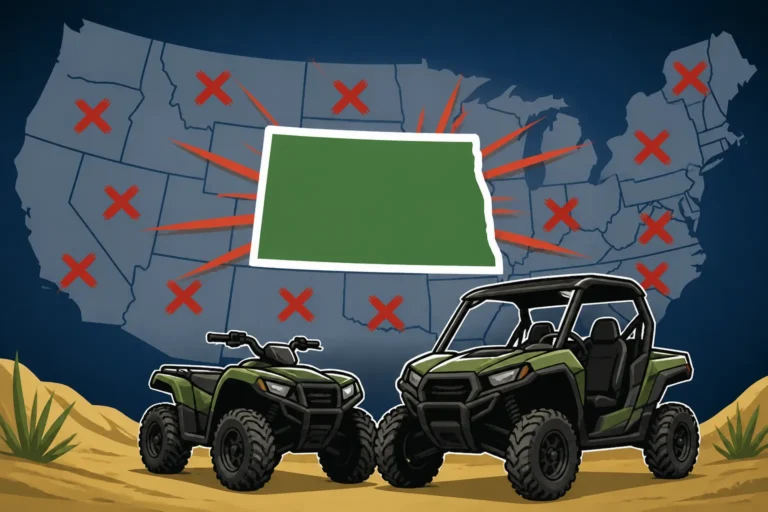
North Dakota is described as having no general reciprocity with other states for OHV permits. In practical terms, you should not plan a trip on the assumption that your home-state registration sticker automatically satisfies North Dakota’s visitor-permit requirement. Review North Dakota Has No Reciprocity With Any State before relying on an out-of-state registration as your only paperwork.
This can feel frustrating if you already paid to register the machine at home. The key distinction is that registration in one state and permission to operate in another are not necessarily the same thing. Each state sets its own rules for visiting machines, and the fact that a machine is legal where it is stored does not settle what North Dakota requires on a North Dakota trail.
For example, a rider from Moorhead might tow an ATV to a North Dakota riding area and see a valid Minnesota decal on the fender. That decal may help show the machine is registered at home, but it does not answer the separate question of whether North Dakota requires a nonresident permit. Check the visitor rules first, and keep home-state papers available as supporting documents.
How the 30-day rule fits in
North Dakota’s out-of-state rule is often discussed in terms of how long a visiting machine can remain in the state before registration obligations may change. That is not the same question as whether a visitor needs an OHV permit for a ride. A time limit connected to registration should not be treated as a blanket exemption from every other permit requirement.
A weekend visitor and someone keeping a machine at a North Dakota lake cabin for an extended stay have different planning needs. The weekend rider should confirm the permit before the first ride. The longer-term visitor should also ask whether the machine’s length of stay triggers registration or other paperwork. Read North Dakota’s 30-Day Out-of-State Rule carefully and distinguish “how long may this machine remain under an out-of-state status?” from “what do I need to ride it today?”
If your stay may extend beyond the short visit you originally planned, do not wait until the last day to investigate. Keep the date the machine entered North Dakota, the home-state registration details, and any purchase or ownership documents together. If the stay changes, contact the appropriate state office or review the current official instructions before continuing to operate the machine.
Permit versus North Dakota registration
A non-resident permit is for a visiting rider or machine under the visitor rules. North Dakota registration is a separate process associated with machines that need to be registered in the state. Which route applies depends on residency, the machine’s status, the length of time it is kept in North Dakota, and the activity planned.
A visitor should not buy a permit and assume it settles every registration question. Conversely, a person who must register a machine in North Dakota should not assume a visitor permit is an alternative that avoids registration. The distinctions matter most for people who move to the state, leave a machine at a second home, or keep a vehicle in North Dakota for a lengthy period.
A helpful starting point is North Dakota Registration Versus a Non-Resident Permit. If you recently moved, are staying for an extended period, or are storing a machine in the state, compare the two categories rather than relying on advice meant for a weekend visitor. The right paperwork can change when your circumstances change.
| Your situation | What to check | Why it matters |
|---|---|---|
| Visiting for a short ride | Non-resident OHV permit and riding-area rules | Home-state paperwork may not replace North Dakota authorization |
| Bringing more than one machine | Permit requirements for each machine | A permit may not cover multiple vehicles |
| Keeping a machine in North Dakota for an extended stay | The out-of-state time rule and registration requirements | A longer stay may create obligations beyond a visitor permit |
| Riding in a state park | OHV permit plus park entrance requirements | These permissions serve different purposes |
| Riding on private land | Landowner permission and any applicable legal requirements | A permit does not grant access to someone else’s property |
Who needs a permit and what exceptions to examine
Common situations where visitors should plan to get one
If you live outside North Dakota and are bringing an ATV or UTV to ride in the state, treat the non-resident permit as a required item to investigate before your trip. This is especially important when your machine carries a different state’s registration decal. Do not wait until you reach the trailhead to find out whether your home-state documents are enough.
The same preparation applies whether you are riding for an afternoon or planning a longer holiday. A rider heading to Pembina Gorge, Turtle Mountain, Kimball Bottoms, or another OHV area should check the visitor permit rules alongside local access, trail conditions, and any machine-width restrictions. “I’m only riding for a few hours” is not a reliable reason to skip a permit check.
Groups should make a list of machines, not just a list of people. If a family brings three ATVs and a side-by-side, record each machine’s make, model, VIN, and home-state registration information. This makes it easier to confirm what is covered, avoid mixing up permits, and solve a problem if a decal or receipt is misplaced.
Exceptions are narrow and situation-specific
Some uses of an OHV may fall under exemptions, such as certain private-land-only use or organized sporting events. Those exemptions are not a general permission to ride without checking the rules. They may depend on where the machine is operated, whether the activity qualifies, and whether the machine ever enters a public riding area or roadway.
A rider using a machine only on a privately owned farm, for example, should not assume that the same exemption applies once the machine is driven to a public trailhead. The boundary between private property and public access can change the legal picture. Review the details of North Dakota Registration Exemptions Explained and the specific exemption that seems relevant to your situation.
Organized events can also have their own requirements. A race or group event may have event-specific authorization, but that does not necessarily excuse every participant from the normal permit, safety, or equipment rules. Ask the event organizer what paperwork is included and what each rider must obtain independently. Get the answer before traveling, especially if the event takes place on managed public land.
How to handle uncertainty about eligibility
When the rules are unclear, start with the machine and the planned use. Note whether it is an ATV, UTV, tracked dirt bike, or another type of OHV; whether it is registered at home; where it will be operated; and how long it will stay in North Dakota. Those facts are more useful than asking a broad question such as “Do I need a sticker?”
Then compare your situation with the state’s official visitor-permit instructions. The page on North Dakota Permits for Visiting Riders is a useful companion for identifying the visitor category and common questions. If the machine is unusual, such as a tracked dirt bike or a homemade vehicle, check the special rules rather than assuming the standard ATV answer applies.
If you contact an office or park, describe the exact scenario and ask for clarification in plain language: “I live in another state, my machine is registered there, I am bringing one ATV for a weekend, and I plan to ride at this location. What North Dakota authorization do I need?” Write down the answer and any instructions about displaying the permit. Clear details reduce the chance of getting a generic answer that does not fit your trip.
How to buy the permit and prepare your paperwork
Buying online before you travel
If online sales are available for the permit, purchasing before departure is often the least stressful approach. You can complete the transaction at home, save the confirmation, and avoid trying to resolve a registration question on a phone with poor reception at a rural trailhead. Start at the official state purchase channel rather than a third-party page that may not issue the authorization you need.
Follow each prompt carefully. Confirm that the permit is for a nonresident OHV, select the correct machine or machines, and enter the requested details accurately. A typo in a VIN or a wrong vehicle category can create confusion later, especially if the machine is checked against the permit record or the decal information.
Save the confirmation in more than one place. Keep a digital copy on your phone and, if practical, a printed copy with your machine documents. A small waterproof document pouch—available from outdoor retailers or Amazon—can keep the paperwork together with the machine’s registration and insurance information. The pouch is a storage aid, not a replacement for any required display decal.
Buying at a state park or other authorized location
Visitors may also be able to buy a permit at a state park or another authorized sales location. This can be convenient if you are already stopping at a park office, but it is not a good reason to postpone all preparation until arrival. Offices may have different operating hours, and a location that sells park entrance permits may not necessarily handle every OHV transaction.
Before driving out of town, verify that the particular office sells the OHV permit and ask what information to bring. You may need details about the machine and its ownership or home-state registration. Check North Dakota Permits Sold at Any State Park for the applicable sales-channel information, and confirm the current arrangement with the location you intend to visit.
If you are arriving late in the day, traveling during a holiday, or heading directly to a remote trailhead, buying ahead can prevent a frustrating delay. A family that reaches a campground after dark may not want to spend the next morning searching for an office before the first ride. Sorting the paperwork at home leaves more of the trip for riding and less for errands.
What to have ready when applying
Gather the machine’s VIN, make, model, and home-state registration information before starting an application. The VIN is usually on the machine frame, but it can be difficult to read if it is dirty, scratched, or tucked into an awkward location. Photograph it clearly while the vehicle is clean and keep the picture with your travel records.
Also have the owner’s name and contact details available. If someone else is transporting or riding the machine, make sure the people involved know who owns it and where the paperwork is stored. When ownership is shared or the vehicle belongs to a business, confirm that the person applying has the correct authority and information.
A simple folder or waterproof pouch can prevent papers from scattering between the truck, trailer, and campsite. Some riders use a document sleeve or compact organizer from Amazon for copies of the permit confirmation, registration, insurance card, and emergency contacts. Keep the original documents secure, and avoid placing sensitive personal information where it can be seen by anyone walking past the parked machine.
Permit timing, expiration, and machine-by-machine planning
Calendar-year validity and trip dates
North Dakota’s non-resident permits are described as running from January through December, rather than lasting for a rolling twelve months from the day you buy them. That means the date of purchase and the date of expiration are not necessarily separated by a full year. Confirm the validity dates shown during purchase so you know exactly how long the authorization lasts.
This calendar-year structure matters for late-season visitors. Someone buying a permit near the end of the year should not assume it will remain valid through the same month the following year. Check the official purchase details and North Dakota Non-Resident Permits Run January to December before paying, especially if your trip crosses into a new calendar year.
If you take more than one trip, put the expiration date in your phone calendar and in your machine records. A permit that was valid during a summer trip may not cover a later visit after the calendar year changes. The reminder is especially useful when a machine stays at a cabin or with family in North Dakota and is not used regularly.
One permit should not be assumed to cover a whole fleet
A permit may be associated with a particular machine, so plan around each vehicle rather than each rider. If you tow two ATVs, confirm whether both need separate permits. A side-by-side and a quad may also be treated as separate machines even if they are owned by the same household.
Create a basic checklist with one line per vehicle: machine type, VIN, owner, home-state registration, permit status, and expiration date. This can be a note on your phone or a printed sheet in the truck. It is far easier to spot a missing permit at home than after the trailer is unhitched at the riding area.
Do not transfer a permit or decal between machines unless the state’s instructions expressly allow it. A permit that belongs to one vehicle may not become valid simply because the same family member is operating another vehicle. If you sell, replace, or borrow a machine, ask how the permit applies rather than assuming it follows the owner.
Displaying the permit and keeping proof available
Read the instructions that come with the permit about where and how to display it. If a decal is issued, follow the state’s placement directions and make sure it is visible, secure, and not covered by mud, accessories, or a storage bag. A permit that is valid in a purchase record but cannot be identified on the machine may lead to avoidable questions during a check.
Keep proof of purchase accessible while riding. Store a digital confirmation on your phone, but do not rely on phone access alone if you expect weak service, a dead battery, or wet conditions. A printed copy in a sealed pouch can be a useful backup. When photographing or printing documents, check that the important numbers are legible rather than assuming a blurry image will help.
If a decal fades, peels, or is damaged, do not improvise by copying it onto another surface. Ask the issuing agency how to replace or correct it and what proof to carry while the replacement is pending. The same applies if the permit information contains a VIN error: resolve it before the trip where possible, and keep the correction confirmation.
Plan the ride beyond the permit
Check the trail and land-access rules
A permit does not open every route in North Dakota. Before heading out, identify the exact riding area and check its posted rules, maps, seasonal closures, width restrictions, and access points. Pembina Gorge, Turtle Mountain, and the Roughrider OHV Trail have different settings and practical considerations, so a general statewide permit cannot answer every local question.
Public land may be managed by different agencies, and some areas allow motorized travel only on designated routes. An OHV permit is not permission to cross a closed trail, drive through a wildlife area where machines are prohibited, or follow an unofficial track because it looks established. At trailheads, take a moment to read the signs instead of following the first tire marks you see.
Private land requires its own attention. A trail, field edge, or section line may appear open but still be subject to posting or landowner permission rules. Ask before entering private ground, and do not treat the state permit as a substitute for consent. For a broader overview of visitor paperwork and where it applies, see Which Ground a Visitor Permit Opens to You.
Check the machine, rider, and safety requirements
Before travel, inspect the machine’s brakes, tires, throttle, steering, lights, and any required safety equipment. A loose battery connection or weak tire may seem minor in the driveway but become a bigger problem on a remote route. Carry basic tools suited to the machine and a plan for what to do if it becomes disabled.
Match the machine to the route. Some trails have width limits that can rule out a larger side-by-side, even when the machine is properly permitted. Confirm the actual width of your vehicle, including any aftermarket accessories that make it wider, and compare it with the riding area’s posted restriction. A few inches can determine whether a route is suitable.
Rider requirements matter, too. Check helmet rules, safety-training requirements for younger riders, passenger restrictions, and any rules about riding on roads. A child’s age, experience, and ability to operate the machine safely should shape the plan. A permit does not make a machine appropriate for a young or inexperienced rider.
Pack documents and practical gear
Keep the essential documents together: permit confirmation, home-state registration, proof of ownership if available, insurance information, and emergency contacts. A waterproof sleeve can protect paper copies from rain, mud, and spilled drinks. A simple labeled organizer from Amazon may help a group keep each machine’s paperwork separate, especially when several vehicles are traveling on one trailer.
Prepare for North Dakota’s open-country conditions. Wind, changing weather, dust, sudden rain, and long stretches between services can affect a ride more than visitors expect. Bring water, layers, a first-aid kit, a charged phone, and a route plan shared with someone who is not on the ride. Do not count on cell reception throughout every riding area.
Finally, tell the group what to do if riders become separated or a machine breaks down. Agree on a meeting point, keep the route map accessible, and make sure everyone knows who carries the permit copies. A little preparation is much easier than trying to reconstruct a plan after the group has split at an unfamiliar trail junction.
Common visitor scenarios and how to handle them
A weekend rider with an out-of-state registration
Suppose you live in Minnesota, your ATV has a current Minnesota registration, and you are planning a Saturday ride in North Dakota. Do not treat the home-state decal as the full answer. Check whether you need a North Dakota nonresident permit, buy it through an authorized channel if required, and save the proof before loading the ATV.
Next, verify the specific riding area’s rules. A permit does not guarantee that every trail accommodates your machine, and local access may be affected by weather or closures. Confirm the trailhead, parking arrangements, and any state park entrance permit separately so you do not arrive with an authorized OHV but an unprepared truck or trailer.
Bring the home-state registration and insurance information as well as the North Dakota permit proof. These documents answer different questions. If an officer or land manager asks about the machine, having the paperwork together can make the conversation straightforward instead of turning into a search through glove compartments and phone photos.
A visitor keeping a machine at a cabin
A person who leaves an ATV at a lake cabin or family property has a different set of questions from someone who brings a machine for one weekend. Track how long the vehicle remains in North Dakota, where it is used, and whether it continues to qualify under the visitor rules. Do not assume that an annual permit automatically resolves the out-of-state registration issue.
Keep a record of when the machine arrived and when it leaves. If you make repeated trips, note the dates and check whether the applicable rule refers to consecutive time in the state or another measure. The distinction may matter, and a vague memory of “it’s been here most of the summer” is not a useful record if questions arise.
Before the next season, review the permit expiration and the machine’s registration status. A permit that expires at year-end may need to be renewed or replaced for future use, while a change in residence or storage plans may call for North Dakota registration instead. If the situation has become long-term, compare the visitor permit with the state’s registration requirements rather than repeating last year’s process automatically.
A family or group bringing several vehicles
Groups often focus on counting riders and overlook the number of machines. Make a vehicle list before applying, and match each permit confirmation to the right VIN. If one person is handling several purchases, label the records clearly so a receipt for one quad is not mistakenly treated as proof for another.
Share the paperwork plan with the group. Tell every driver where the permit information is stored, who has the printed copies, and what to do if a decal is missing or damaged. This is particularly helpful when the person who bought the permits is riding a different vehicle or is not at the trailhead when the group starts.
For mixed groups, check the rules for each type of vehicle and each rider. A youth ATV, adult quad, and wider UTV may face different practical or regulatory issues. Confirm the machine’s permit status, rider eligibility, and trail compatibility separately. One family’s paperwork should not be treated as a single blanket authorization for every vehicle on the trailer.
Common mistakes and a practical pre-ride checklist
Mistakes that can derail a trip
The first common mistake is assuming that an out-of-state registration automatically transfers to North Dakota. It may be valid at home and still not answer the state’s visitor-permit question. Check the rules before leaving rather than relying on a friend’s recollection from an earlier trip.
Another mistake is confusing the OHV permit with park access, title, insurance, or registration. These are separate issues, and satisfying one does not necessarily satisfy the others. A visitor who has only the OHV permit may still need park entrance authorization or supporting ownership and insurance documents.
A third problem is waiting until arrival to sort out basic details. Permit availability, office hours, poor mobile reception, and a missing VIN can turn a quick stop into a delay. Buying in advance when possible, keeping copies organized, and checking the permit’s expiration date all help prevent avoidable stress.
A simple checklist before loading
Use this checklist several days before your trip:
- List every ATV, UTV, or other OHV you plan to bring.
- Record each machine’s VIN, type, owner, and home-state registration status.
- Confirm whether each machine needs its own North Dakota nonresident permit.
- Check the permit’s purchase instructions, validity dates, and display requirements.
- Save a digital confirmation and carry a readable backup copy.
- Check the exact trail or riding area for access, closures, and width limits.
- Confirm any separate state park entrance or campground requirements.
- Review land-access, road-use, passenger, helmet, and age-related rules.
- Pack registration, ownership, and insurance information where the group can find it.
- Share the route and emergency plan with everyone traveling.
This checklist is not a substitute for the official rules, but it catches the details most likely to be missed when the group is focused on loading machines and getting on the road. If something does not match your situation—such as an unusual vehicle, an extended stay, or unclear ownership—pause and ask before you ride.
Where to confirm details before departure
Use the state’s official permit information and purchase instructions for the final details. The page on North Dakota Non-Resident Permit Cost can help identify the fee topic, but check the amount shown by the official sales channel before purchasing because government fees can change. Keep the transaction confirmation until the trip is over.
If you are unsure whether a missing or expired permit creates a problem, do not assume a receipt from another state will settle it. Review North Dakota Penalties for No Permit and resolve the paperwork before operating the machine. It is easier to correct an application at home than to deal with a citation or a disrupted ride at the trailhead.
For a visitor who already has a home-state sticker, Visiting North Dakota With Only a Home-State Sticker is a useful topic to review alongside the reciprocity rules. The safest preparation is to know which document serves which purpose, carry the necessary proof, and confirm that the machine and route are both eligible for the planned ride.
Disclaimer
This article is for general informational purposes only and does not constitute professional advice. Laws, prices and regulations vary by location and change over time. Consult a qualified professional for guidance on your specific situation.