Cattle Guards and Open Range
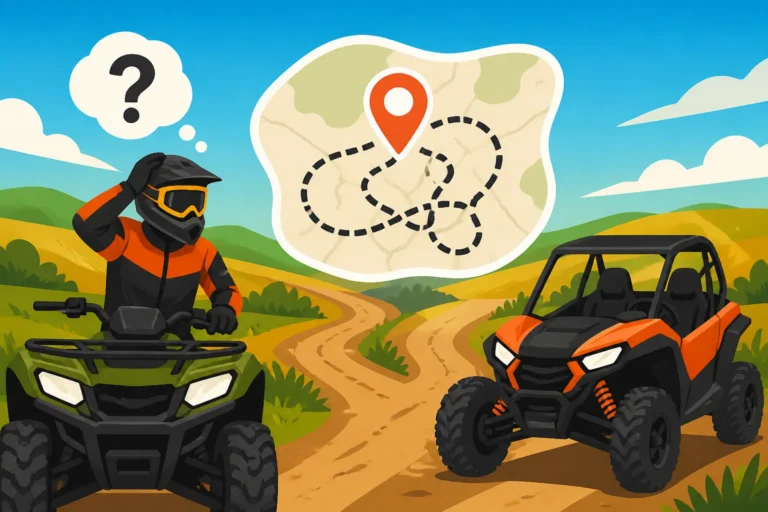
A cattle guard on a North Dakota road can look like a simple continuation of the route, but it doesn’t tell you whether an ATV or UTV is allowed to be there. Open-range country, private land, and public access routes can overlap in confusing ways. This guide explains how to check your route, approach cattle guards safely, and avoid disturbing livestock or crossing onto land without permission.
What a cattle guard means for ATV and UTV riders
A cattle guard controls livestock, not public access
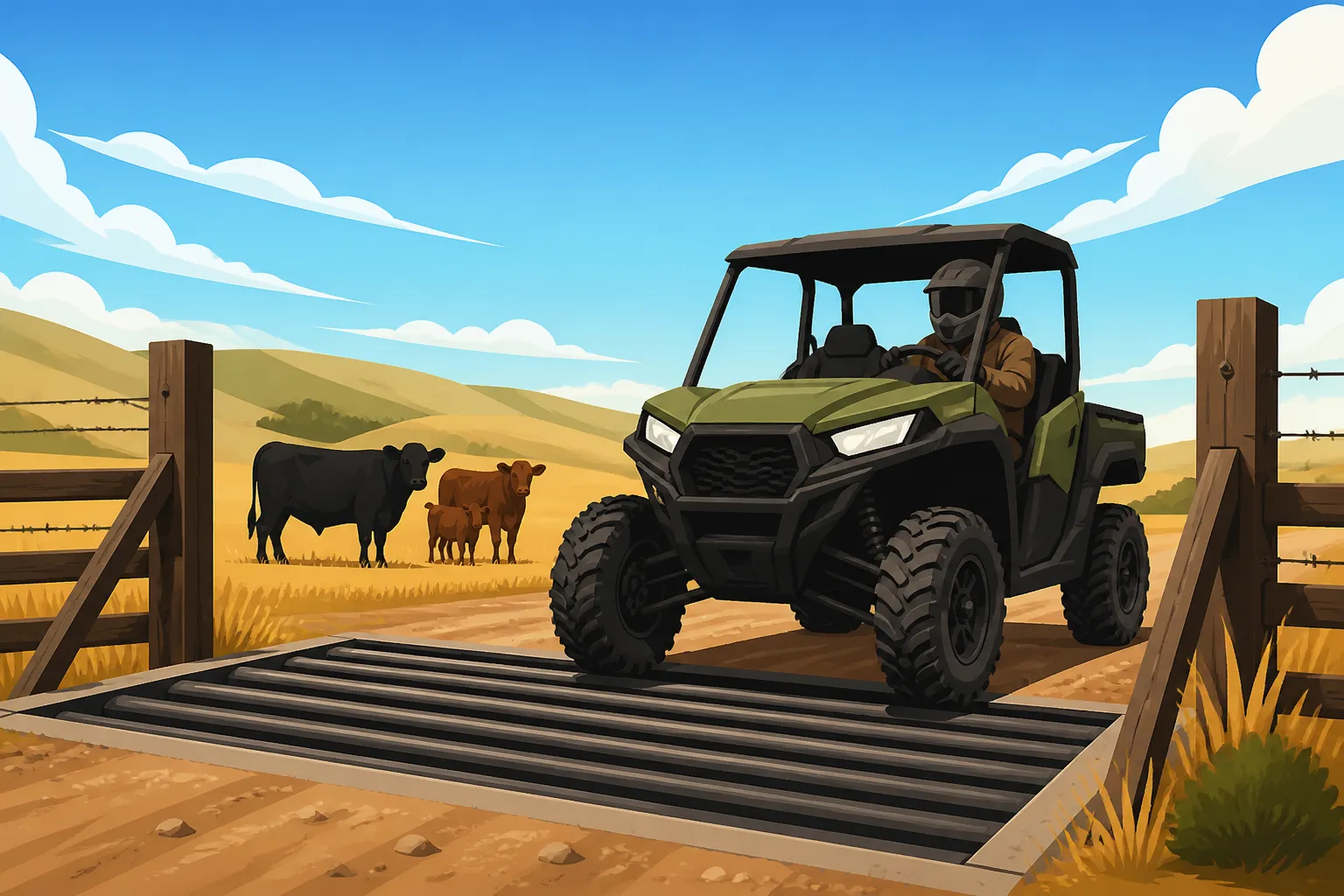
A cattle guard is designed to discourage livestock from crossing while allowing vehicles along a road or track to pass. It is not a sign that the route is public, that motorized travel is permitted, or that you may continue beyond it. A road can pass through open-range country and still cross private property or land where motorized travel is restricted.
That distinction matters when you’re riding in western North Dakota or near public-land areas such as the Little Missouri National Grassland. A visible track may appear to lead toward a scenic overlook, a creek crossing, or a marked trail, but its appearance does not establish who owns the land or whether your machine is allowed on it. Check the route before you reach the guard, rather than making the decision from the seat of your machine.
For public grassland routes, use the applicable motor vehicle use map and follow the routes designated for motorized travel. Reading a Grassland Vehicle Use Map is a useful place to start if the map symbols and route markings feel unfamiliar. For a broader explanation of how public roads and their management fit together, see Grassland Roads and Who Manages Them.
Open range does not mean open riding
“Open range” generally describes an area where livestock may roam rather than being confined behind a fence along every road. It does not mean that all land is open for recreation. Riders still need to distinguish between a designated public route, a private road, and an unauthorized track that happens to be visible.
This can be especially easy to misread on the prairie. Fences may be far apart, gates may be open, and a ranch road may look nearly identical to a public access road. A cattle guard can sit on a route that is open to traffic, but it can also be part of a private livestock enclosure or a boundary you do not have permission to cross. When you’re unsure, stop and check the route instead of treating the lack of a closed gate as permission.
Motorized travel on national grasslands is generally limited to designated roads and trails, not unrestricted cross-country travel. Before planning a route through grassland, review North Dakota Grassland Motor Vehicle Use Maps and North Dakota Cross-Country Travel Is Banned. A line on a general navigation map should not override a land manager’s route designations or posted restrictions.
How to check whether your route is authorized
Confirm the route before you leave
Start with the land manager’s information for the area you intend to ride. Check whether the specific road or trail is open to the type of machine you’re taking, and look for seasonal or weather-related closures. A route that appears in a mapping app may be a road, a private access track, or a route intended for a different kind of use.
This is where a navigation tool such as onX Offroad can help you review your planned route and notice where it approaches property boundaries or mapped roads. Treat it as a planning aid, not as the final authority on legal access. Compare what you see in the app with official land-management maps, local signs, and any instructions posted at the trailhead or along the route. If the information conflicts or the status is unclear, choose a route you can confirm.
It helps to download or save the relevant map information before riding, especially in remote areas where cell service may be unreliable. Mark a planned turnaround point before you reach a confusing junction or cattle guard. That way, you’re not pressured to keep going simply because the route is difficult to retrace.
Read signs, fences, and gates as separate clues
A cattle guard, a fence, a gate, and a posted sign each provide different information. The guard may help contain livestock; the fence may mark a property or pasture boundary; the gate may provide an authorized access point; and the sign may state restrictions or identify the landowner’s rules. One clue does not replace the others.
Pay close attention to signs before and after a crossing. A route may be permitted up to a particular point but not beyond it, or access may be limited to specific users. If a gate is closed, don’t assume you can open it and continue. Look for instructions, posted contact information, or a clearly marked public route. If the route appears private, seek permission rather than relying on a map line or an open gate.
A route check should include the ground immediately beyond the cattle guard. Look for a posted sign, another gate, a marked trail, or a change in the road surface that may indicate a junction or boundary. If you can’t tell where the authorized route goes, stop before crossing and turn around if you cannot confirm access. North Dakota Posted Land Rules for Riders covers why posted-land information matters, while Landowner Permission in Writing is relevant when your intended route depends on private access.
| What you see | What it may tell you | What to do |
|---|---|---|
| A cattle guard with no clear route marking | Livestock are being controlled; access is still uncertain | Check the official map and nearby signs before crossing |
| A designated public road or trail on the applicable map | The route may be open for the use shown on that map | Confirm machine type, closures, and on-site restrictions |
| A closed gate or posted restriction | Access may be limited or prohibited | Do not proceed unless the instructions clearly authorize access |
| A track shown only in a general navigation app | A road or track may exist, but its access status may be unclear | Verify it with land-manager information and signs |
| Livestock near the road or guard | Animals may move unpredictably, even if the route is open | Slow down, give them room, and avoid startling or chasing them |
How to approach and cross a cattle guard safely
Slow down and assess the crossing
Cattle guards can be hazardous for ATVs and UTVs. The bars create an uneven surface, and the gaps may catch or destabilize tires, especially if a rider approaches too quickly or at an angle. Mud, gravel, snow, ice, or loose vegetation can make the approach less predictable. A guard that looks easy to cross from a distance may also be narrower than the road or bordered by a ditch or uneven shoulder.
Reduce speed well before the crossing. Look for damage, loose material, standing water, a steep approach, or a bypass gate. Keep your machine under control and follow the manufacturer’s guidance for riding over rough or uneven surfaces. Avoid sharp steering, hard acceleration, and sudden braking on the bars. If you can’t confidently cross, don’t force it. Turn around only when you can do so safely and without blocking the route.
Be particularly cautious when riding with children or passengers. Leave enough space between machines so one rider’s hesitation does not cause another to crowd the guard. If visibility is poor, such as in blowing snow, tall grass, or fading light, stop at a safe distance and assess the crossing before moving forward. A passenger should remain seated and follow the machine’s safety instructions rather than shifting weight unexpectedly.
Use gates correctly and protect livestock
Some crossings have a gate alongside the cattle guard. Use it only if the route and any posted directions allow you to do so. If you open an authorized gate, close and latch it exactly as you found it. Leaving a gate open can let livestock onto a road or into an area where they should not be, creating risks for ranchers, other road users, and the animals themselves.
If cattle are near the crossing, slow down and give them time and space. Don’t honk repeatedly, rev your engine, chase them, or try to push them away from the guard. Livestock can bunch together, turn suddenly, or move toward a machine when startled. Wait for a clear, safe path. If the animals block the route and there is no safe way through, turn back or contact the land manager or landowner using information posted at the site.
The same courtesy applies when you meet other riders or vehicles at a narrow crossing. Don’t crowd another machine onto the guard, and don’t assume the person ahead knows the route is open. A calm stop and a short conversation can prevent a collision or an access mistake. North Dakota Trail Etiquette Locals Expect offers more practical guidance on sharing riding areas responsibly.
Planning a ride through cattle country
Build a route with a fallback
Before setting out, identify the roads and trails you intend to use, note any cattle guards or gates marked along the way, and choose a safe place to turn around if access is uncertain. When a route crosses public and private land, check the sections separately. Permission to ride one segment does not automatically grant permission to travel through a neighboring parcel.
A tool such as onX Offroad can make it easier to review a route and spot places where it approaches mapped property boundaries or access points. Use it alongside official maps and local signs, not instead of them. Save key route information for offline use where possible, and tell someone where you plan to ride if you’re heading into a remote area.
Have an alternate route that uses confirmed public roads or designated trails. This matters in areas where a short stretch of private road or a closed gate could otherwise leave you with no safe way to continue. For information about trail access and changing conditions, review North Dakota Trail Status by App and Phone before you go. Conditions can change, so check for current closures rather than assuming last season’s route is still available.
What to do when the situation is unclear
If you reach a cattle guard and cannot confirm that your route is open, stop before crossing. Check nearby signs and your official map. If you still cannot establish access, don’t ride through simply because the gate is open, a vehicle has passed, or the route appears on a digital map. Turn around when safe, take a confirmed route, or contact the relevant land manager or landowner.
If you find a damaged guard, an unsecured gate, or livestock on a road, avoid making the problem worse. Don’t attempt repairs or move animals unless you have permission and know what to do. If there is an immediate hazard, use posted contact details or contact the appropriate local authority. Be prepared to describe your location using a road name, trail marker, nearby landmark, or saved map point.
The most useful habit is to separate three questions: Is the route open to motorized travel? Is it open to my type of machine? And can I cross this particular guard safely right now? A “yes” to only one or two of those questions is not enough. Taking a few minutes to confirm all three can prevent a dangerous crossing, an unwanted encounter with a landowner, or an unplanned turn back miles from your starting point.
Disclaimer
This article is for general informational purposes only and does not constitute professional advice. Laws, prices and regulations vary by location and change over time. Consult a qualified professional for guidance on your specific situation.