Turtle Mountain Shared With Horses
A ride through Turtle Mountain can feel wonderfully quiet until a bend brings you face-to-face with a horse and rider. The safest response is not to assume the trail belongs to one type of user: slow down early, give horses room, and follow the route’s current access rules. This guide explains how to plan and ride considerately around shared use near Bottineau.
What shared use means at Turtle Mountain
Expect different users and different reactions
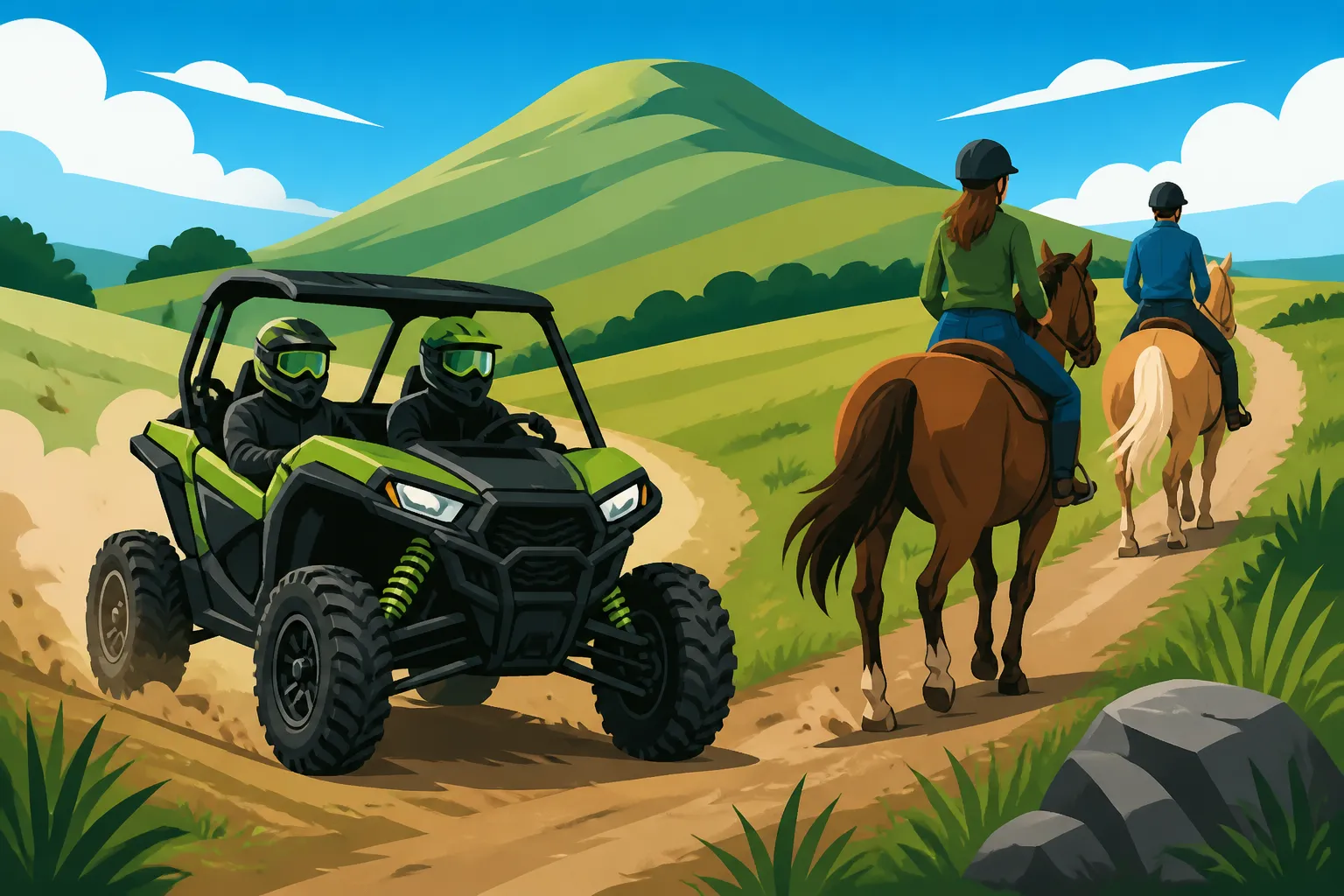
Turtle Mountain is a riding area where motorized recreation and horseback riding can overlap. That makes awareness especially important: horses may startle at engine noise, sudden movement, or a machine appearing quickly around a blind corner. A horse that seems calm from a distance may react differently when an ATV or side-by-side approaches.
The safest assumption is that you could encounter another trail user at any time. Horses may be moving in a group, walking slowly, or stopping while a rider adjusts tack. You may also meet walkers or other off-highway vehicle riders. Staying alert is more useful than relying on the trail seeming empty during the first few minutes of your ride.
Shared use does not automatically mean every route is open to every activity. Access can depend on the specific trail, posted signs, seasonal conditions, and current management rules. Before unloading, check the official information for the area and confirm that the route you intend to ride allows your type of machine. For an overview of the riding area, see [Turtle Mountain Riding in North Dakota].
Check the route before you unload
A map can help with orientation, but it does not replace posted rules or current local guidance. Look for the trailhead’s signs and any notices about closures, permitted users, direction of travel, or temporary conditions. If something at the trailhead conflicts with an older map or an online route description, treat the on-site notice as a reason to pause and verify before continuing.
This matters particularly when you arrive with a trailer, several riders, or a schedule that makes it tempting to get moving quickly. Take a few minutes to identify the trail entrance, confirm where motorized riding is allowed, and agree on what to do if the group becomes separated. It is much easier to sort out uncertainty in the parking area than after your group has committed to a route.
Digital navigation can be helpful for seeing your position and keeping track of a planned route. Some riders use onX Offroad to organize their trip, but a mapped line should not be treated as proof that a trail is open or appropriate for your machine. Check current local information, follow signs, and use a map as a planning aid rather than permission.
How to approach horses safely
Slow down before you reach the horse
When you see a horse ahead, ease off the throttle early. Reducing speed well before you arrive gives the rider time to notice you and gives you more room to respond if the horse becomes uneasy. Avoid accelerating, revving, or making a sudden turn near the animal. If the trail is narrow or visibility is limited, stop at a safe distance instead of trying to squeeze past.
Let the horse rider decide how to manage the encounter. They may ask you to wait, move to one side, or proceed slowly. A calm conversation from a distance can help, but don’t approach the horse on foot unless the rider invites you to do so. A person who knows their horse can usually tell you what will make the meeting less stressful.
Keep the machine steady and predictable. Abrupt braking, spinning tires, or a fast departure can be more startling than a quiet, controlled pause. Once the rider indicates it is safe to pass, move slowly, leave as much space as the trail allows, and continue at a gentle pace until you are well clear. Do not assume that one horse’s calm response means every horse will react the same way.
Give riders space and time
Passing requires more than choosing a wide spot. The rider may need to position the horse, shorten the reins, or wait for other members of their group. If you are riding with friends, make sure everyone knows to stop and wait rather than bunching up around the horse. A line of idling machines can create more noise and pressure than a single rider.
If the trail is too narrow to pass safely, wait for a wider area or follow the rider’s directions. Do not drive off the trail to make room unless the rider and site rules make that appropriate; leaving the established route can damage vegetation, disturb the ground, or create a new path. On sloped or uneven ground, an improvised pass can also put the machine, horse, and people in a less stable position.
A useful way to think about the encounter is to remove urgency. You may lose a few minutes by waiting, but that pause can prevent a frightened horse, an injured rider, or damage to the trail. These practical habits are part of the broader etiquette covered in [North Dakota Trail Etiquette Locals Expect] and apply anywhere motorized and non-motorized users share space.
| Situation | Safer response | Avoid |
|---|---|---|
| A horse appears around a bend | Slow down immediately and stop if needed | Rushing toward the horse to get past |
| The trail is narrow | Wait for a suitable passing place and follow the rider’s directions | Squeezing by or leaving the route without checking |
| Your group is behind you | Have every rider stop and keep a calm distance | Letting the group crowd the horse |
| The horse seems unsettled | Stay still, quiet the machine, and give the rider time | Revving, shouting, or making sudden movements |
| You are unsure whether the route is open | Check signs and current area guidance | Treating a mapped line as authorization |
Plan a considerate Turtle Mountain ride
Prepare the group before entering the trail
Before setting off, tell everyone in your group that horses may be present and agree on a simple response: slow down, stop at a safe distance, and let the horse rider guide the pass. This is especially useful when the group includes newer riders who may not know how their engine noise or quick movements can affect an animal.
Choose a lead rider who is comfortable making decisions at a conservative pace. Ask the rest of the group to leave enough space that they can stop without crowding the rider in front. If someone does not see why the group has stopped, they should wait for an explanation rather than riding around the line. A few minutes of clear planning can prevent confusion when visibility is poor or the trail is busy.
Check your machine before the ride, too. A sticking throttle, loud exhaust, or unreliable brakes can make it harder to move calmly around other users. Bring water, basic recovery equipment, and a charged phone or navigation device. Cell coverage can vary in outdoor areas, so don’t make an online map or live signal your only way to find your way back.
Use maps carefully and leave room for changing conditions
A navigation app can help you orient yourself, review a route, and avoid wandering onto an unintended path. If you use onX Offroad, save relevant map information before heading out when possible and compare your planned route with official signs and area guidance. Treat changes in the trail, barriers, and posted notices as important information—not obstacles to work around.
Turtle Mountain’s terrain and trail conditions may not feel the same from one visit to another. Mud, fallen branches, poor visibility, and other users can affect how comfortable a route is for your group. If conditions make a narrow section difficult to navigate politely, turning back can be the best decision. Being able to complete a planned loop is less important than leaving the trail in good condition and avoiding a risky encounter.
If you are bringing a side-by-side, confirm that the particular route and any restrictions suit your machine’s dimensions. A machine that fits comfortably on one trail may not be appropriate on another. Guides to [North Dakota Trails With Width Limits] and [North Dakota Trails That Allow Side-by-Sides] can help you think through trail fit, but verify the area’s own current rules before you travel.
Trail etiquette that protects everyone
Keep noise, speed, and passing under control
A shared trail is not a place to show off how quickly a machine can accelerate. Keep a controlled speed, particularly near blind curves, trail junctions, and places where vegetation blocks your view. Dust and noise can affect other users even when you are not close enough to see them, so ease off when approaching a group or a section where people may be around the next bend.
Use your horn or voice only when it helps communicate clearly and does not startle the horse. A brief, calm announcement from a safe distance may help the rider understand where you are, but loud or repeated blasts are not considerate. If you are uncertain whether the horse has noticed you, stop and wait for the rider to acknowledge your presence.
Avoid following a horse closely. Give the group space to continue at its own pace, and do not pressure the rider to move faster or pull off the trail. If you need to pass, do so only when the rider says it is safe and there is room to move predictably. Once you have passed, continue gently rather than accelerating sharply away.
Respect closures, signs, and other users
Stay on authorized routes and obey signs even when a shortcut looks harmless. Cutting around a closed section or making a new track can damage the area and create confusion for future visitors. If you encounter a closure, turn around or use an explicitly permitted alternative rather than assuming the restriction is optional.
Be courteous in the parking area as well as on the trail. Park your trailer so other visitors can maneuver, keep children and pets close, and avoid blocking trail access. If a horse trailer is already staged nearby, give its occupants room to load and unload safely. Small acts of patience at the trailhead can make the whole visit calmer.
Turtle Mountain is only one part of the state’s riding network, and access rules are not identical across North Dakota. Before planning another trip, review [North Dakota OHV Trails: All Four Riding Areas] and [North Dakota OHV Trail Map Downloads]. For area-specific details around Bottineau, [Turtle Mountain Northwest of Bottineau] and [Finding the Sjule Road Entrance to Turtle Mountain] can help you plan your approach without assuming that every route is suitable for every rider or machine.
If you have a question about current access, ask the responsible land manager or another local authority before riding. That is particularly worthwhile when signs are unclear, conditions have changed, or you are unsure whether a route is open to motorized use. Thoughtful planning makes a shared trail more comfortable for horse riders, ATV and UTV riders, and everyone else who comes to enjoy Turtle Mountain.
Disclaimer
This article is for general informational purposes only and does not constitute professional advice. Laws, prices and regulations vary by location and change over time. Consult a qualified professional for guidance on your specific situation.