North Dakota County and City ATV Ordinances
Riding an ATV or UTV in North Dakota is an absolute blast, a true part of the prairie lifestyle, but few things are more frustrating than trying to understand exactly where you can legally ride, especially when you factor in all the local rules. It often feels like a giant, confusing puzzle where state laws offer a general picture, but then every county and city comes along with their own unique pieces, sometimes contradicting what you thought you knew. This guide is here to untangle that knot, helping you navigate the sometimes baffling world of North Dakota county and city ATV ordinances so you can ride with confidence and avoid an unwelcome ticket.
The Frustration of Local Laws: Why It's So Confusing
There's nothing quite like the freedom of hopping on your ATV or UTV and exploring the wide-open spaces of North Dakota. But that sense of freedom can quickly turn into a headache when you start trying to figure out if you're actually allowed to be on that particular road, ditch, or trail. Many riders assume that if state law permits something, it's universally true, only to discover a local ordinance that throws a wrench in their plans. This creates a huge amount of confusion and can lead to unintentional violations, leaving riders feeling targeted and unsure.
State Law vs. Local Control: A Balancing Act
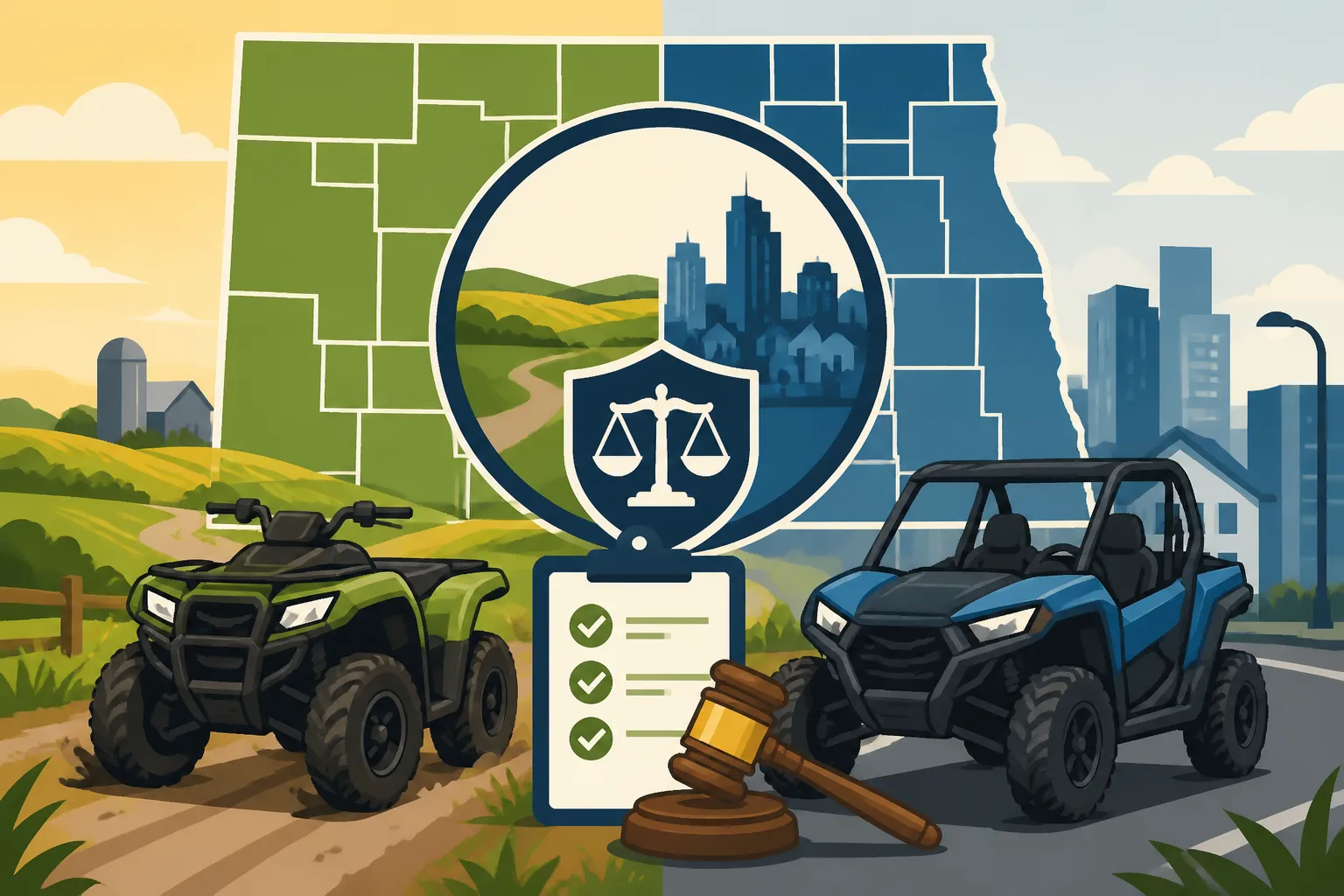
North Dakota's state laws provide the foundational framework for off-highway vehicle (OHV) operation, covering everything from registration requirements to general rules for road use. This statewide approach aims to create a consistent set of guidelines for all riders. However, the state also recognizes that local communities have unique needs, traffic patterns, and concerns. Because of this, counties and cities are often granted a degree of "home rule" or specific statutory authority to enact their own ordinances that further regulate OHV use within their specific boundaries.
This dual system, while designed to balance broad state interests with hyper-local concerns, inevitably creates challenges for riders. What might be perfectly legal on a county road outside city limits could be strictly prohibited the moment you cross into a township or municipality. For example, the state might permit ditch riding in certain areas, but a specific county ordinance could impose additional restrictions, perhaps related to crop seasons or specific road characteristics. Navigating this intricate web requires more than just a passing familiarity with state statutes; it demands an understanding of how local governments can add, subtract, or modify those overarching rules. It’s like learning a language, then realizing there are a dozen different dialects, each with its own quirks.
The "Where Can I Ride?" Dilemma
Every OHV owner in North Dakota has likely faced the "Where can I ride?" dilemma. You've got your machine registered, you know the basic state laws, but then you pull out a map, look at a stretch of road, or consider a route through a small town, and uncertainty creeps in. Is this gravel road open? Can I cut through this city block to get to the trailhead? Will the county sheriff see me differently than the state trooper? These questions are completely valid because the answers truly do change from one jurisdiction to the next.
The result is a patchwork of local rules that can feel impossible to keep track of. Imagine you're planning a weekend ride with friends, starting in one county, crossing into another, and maybe even passing through a small town or two. Each segment of your journey could have a different set of unwritten (or poorly publicized) rules that could get you into trouble. It's not uncommon for riders to hear conflicting advice from different locals or even different law enforcement officers, adding to the frustration. This lack of clear, centralized information is a significant pain point for the riding community, often forcing responsible riders to either risk a fine or stick to known trails, limiting their exploration of North Dakota's beautiful landscape.
Understanding County-Level Ordinances in North Dakota
North Dakota's counties play a significant role in shaping the OHV landscape, often dictating where and how you can ride outside of incorporated city limits. While state law provides broad allowances, individual counties have the authority to fine-tune these regulations based on their specific demographics, agricultural needs, and local infrastructure. It's a critical layer of governance that every rider needs to understand.
How Counties Implement OHV Rules
County-level OHV rules in North Dakota are typically established by the county commission, which is the governing body for the county. This process usually involves public hearings, where local residents, landowners, and OHV enthusiasts can voice their concerns or support. The decisions made at this level often reflect the unique characteristics of the county – whether it's primarily agricultural, has significant recreational areas, or experiences heavy traffic on its rural roads. For example, a county with a large amount of public land and designated trails might be more open to OHV use on certain roads, while a county dominated by sensitive agricultural areas might impose stricter limits during planting or harvest seasons.
Once an ordinance is passed, it falls to the county sheriff's department and other local law enforcement agencies to enforce these rules. This means that a sheriff's deputy patrolling a county road will be looking for compliance not just with state law, but also with any specific county ordinances that apply. This is why it's so important to understand the local regulations: you might be perfectly legal under state statutes, but a violation of a specific county rule could still lead to a citation. Knowing the process helps you understand why these rules exist and who enforces them.
Common County Restrictions and Permitted Areas
When it comes to county ordinances, you'll often find a mix of restrictions and designated areas. Some counties might, for instance, have speed limits specifically for OHVs that are lower than the posted speed limit for cars on certain gravel roads. Others might restrict the hours of operation, perhaps banning night riding on county roads to reduce noise complaints or prevent accidents involving agricultural equipment. You might also encounter bans on specific types of OHVs on certain routes, or seasonal restrictions designed to protect roads during spring thaw.
Conversely, some counties have taken proactive steps to open up specific areas or roads for OHV use, often in conjunction with state recreational efforts or local trail systems. These might include designated gravel roads that connect trail segments or provide access to remote hunting and fishing spots. It's not uncommon for counties to publish maps or lists of approved roads, which are invaluable resources for riders. Checking the county's official website or contacting the county auditor's office or sheriff's department directly is always your best bet. Remember that [North Dakota Counties That Restrict Riding] are well within their rights to do so, and staying informed is key to enjoying your ride without incident.
North Dakota's Ditch Riding and County Nuances
Ditch riding is a quintessential North Dakota OHV experience, legally permitted by state law in many situations. The state statute generally allows registered OHVs to operate on the "back-slope and bottom of a ditch" of a public highway. This means staying off the actual paved or gravel shoulder and the traveled portion of the road. However, even with this statewide allowance, counties can introduce nuances that are crucial to understand.
A county might have specific interpretations or additional rules regarding ditch riding within its borders. For instance, a county with particularly narrow ditches or high-traffic rural roads might discourage ditch riding in certain areas for safety reasons, or they might have ordinances related to damaging vegetation in the ditch during specific times of the year. While the core principle of ditch riding might be consistent, the practical application can vary. It's vital to remember that the state's permission often comes with conditions, and local governments can add to those conditions. Understanding [Riding North Dakota's Ditch Bottom and Back-Slope] is a great start, but always check if your specific county has added its own layer of rules to this popular riding practice. Failing to do so could lead to a conversation with a local deputy that you'd rather avoid.
Navigating City-Specific ATV & UTV Regulations
Riding your ATV or UTV in an urban or even semi-urban environment in North Dakota introduces an entirely new set of rules and challenges. Cities, by their very nature, have different concerns and priorities than rural counties, and their ordinances reflect that. What might be permissible on a sprawling county gravel road is almost certainly not allowed within the tight confines and higher population density of a city.
Why Cities Have Different Rules Than Counties
Cities in North Dakota operate under distinct conditions that necessitate different OHV regulations compared to their rural county counterparts. The primary concerns in urban areas typically revolve around noise, pedestrian safety, vehicular traffic congestion, and potential damage to public infrastructure like paved roads and sidewalks. An ATV or UTV, especially one with aftermarket modifications, can be quite loud, leading to significant quality-of-life complaints from residents. Additionally, the sheer volume of cars, trucks, and pedestrians in a city makes open OHV operation a much higher safety risk.
Furthermore, city infrastructure isn't designed for the knobby tires and suspension travel of an off-road machine. Pavement can be damaged, and crossing sidewalks or city parks can create hazards. For these reasons, cities are almost universally more restrictive. While [North Dakota Cities Cannot Require Local Registration] for your OHV, they absolutely can, and often do, restrict where, when, and how you operate it within their corporate limits. Their goal is to maintain public order, ensure safety for all residents, and protect urban environments, which means OHV access is often heavily curtailed.
Typical City Ordinances: Speed, Hours, and Access
When you look at city ordinances across North Dakota, you'll find a common thread of restrictions designed to limit OHV impact. Speed limits for OHVs, even on allowed routes, will typically be very low – often 15 or 20 mph – reflecting the urban environment. Hours of operation are almost always restricted to daylight hours, and usually only between certain times, like 8 AM to 8 PM, to prevent late-night noise disturbances. Many cities flat-out prohibit OHVs on residential streets, allowing them only on designated routes or specific thoroughfares for the purpose of getting to a legitimate destination outside city limits.
Access is another major point of control. Instead of open road access, cities might only allow OHVs on the shortest, most direct route to exit the city, or to access specific trails or private property on the city's fringe. For larger cities like Fargo or Bismarck, navigating these rules can be particularly tricky due to their size and complex road networks. For instance, [North Dakota Rules for Riding in Fargo] will be much different than a small agricultural town. Similarly, [North Dakota Rules for Riding in Bismarck] will focus heavily on public safety and noise reduction in a bustling capital city. Always assume that unless explicitly stated otherwise, riding an OHV on city streets is prohibited.
Permitted City Operations: Specific Cases
Despite the general restrictiveness, there are specific instances where cities might permit OHV operation. These are typically highly controlled situations:
- Parade Permits: If you're part of a community event like a parade, you can often get a temporary permit to operate your OHV on city streets for the duration of the event. This is usually managed through the city clerk's office or special events department.
- Utility or Municipal Work: City employees or contractors using OHVs for maintenance, snow removal, or utility work are usually exempt from general prohibitions, as their operation serves a public purpose. Farmers might also have specific allowances to move equipment across city roads for short distances when accessing fields that border the city, but these are often narrow exemptions and require verification.
- Direct Access Routes: Some cities, especially those with popular nearby trail systems, might designate specific routes or roads that OHV owners can use to travel directly from their residences or staging areas to the trailheads. These routes are typically well-marked and come with strict rules about speed and conduct. For example, a town near a riding area might have specific roads open to OHVs to allow riders to access nearby gas stations or restaurants.
It’s crucial to understand that these are exceptions, not the rule. If you plan to operate your OHV within city limits for any reason, you must verify the specific ordinance with the city clerk or local police department. Don't rely on assumptions or anecdotes; get the official word.
Key Legal Considerations and What to Look For
Understanding the legal landscape surrounding North Dakota's county and city ATV ordinances means delving into a few core legal principles and knowing how to properly research the rules that affect your ride. It's not just about knowing what's allowed, but why, and how to find the definitive answers.
The Doctrine of Home Rule and Its Impact
The concept of "Home Rule" is a cornerstone of local governance in many states, including North Dakota. In essence, it grants local governments – like counties and cities – a significant degree of autonomy to manage their own affairs, particularly regarding matters that are primarily local in nature. This includes zoning, traffic regulations, and public safety, all of which directly impact OHV use. Because OHV operation often involves local land use, noise, and traffic, it falls squarely within the scope of matters where cities and counties can exercise their home rule powers.
The impact of home rule on OHV regulations is profound. It means that while North Dakota state law establishes a baseline for OHV operation (e.g., registration requirements, general road use guidelines), local governments are empowered to add more stringent rules, create specific prohibitions, or designate unique riding zones within their jurisdiction. This is why you often encounter variations from one county to the next, or dramatic differences between a city and the surrounding rural areas. Conflicts can arise if a local ordinance directly contradicts a state law, in which case state law generally supersedes the local rule. However, most local ordinances are crafted to supplement state law, adding restrictions or conditions that are not explicitly forbidden by the state. This creates the complex, multi-layered regulatory environment that riders frequently find challenging to navigate.
Reading and Researching Local Ordinances
When you're trying to figure out the rules for a specific county or city, simply asking around might give you anecdotal information, but it's not a reliable legal source. You need to go directly to the source. Here's a step-by-step guide on how to research local ordinances:
- Start with the County/City Website: Most North Dakota counties and cities have official websites. Look for sections related to "Ordinances," "Codes," "Law Enforcement," or "Public Works." Many will have their municipal code available online, often searchable by keyword. Use terms like "off-highway vehicle," "ATV," "UTV," "all-terrain vehicle," or "recreational vehicle."
- Contact the County Auditor or City Clerk: These offices are the official custodians of local ordinances. They can direct you to the relevant sections of their code or provide copies. They often deal with [North Dakota Registration Questions Clerks Hear] and might also know about OHV rules. Be polite and specific about what you're asking.
- Call the Local Law Enforcement Agency: The county sheriff's office or city police department is responsible for enforcing these rules. While they might not be able to cite specific code numbers on the spot, they can usually tell you what is generally permitted or prohibited in their jurisdiction. They are often the best source for practical interpretation.
- Visit in Person (If Possible): For smaller communities or if online resources are limited, a visit to the city hall or county courthouse can be effective. You can often review the physical code books.
Remember that ordinances can change, so always ensure you're looking at the most current version. A brief phone call before a trip can save you a lot of hassle and potential fines.
Understanding Enforcement and Penalties
Violating a county or city OHV ordinance in North Dakota can lead to significant consequences, just like breaking a state law. The penalties can vary widely depending on the severity of the infraction, the specific ordinance, and the discretion of the enforcing officer.
Typically, a violation of a local ordinance will result in a monetary fine. These fines can range from relatively minor sums for a first offense to much steeper penalties for repeat offenders or more serious infractions (e.g., reckless operation within city limits). Beyond fines, other consequences might include:
- Impoundment: In some cases, especially for egregious violations or if the rider is deemed a significant public safety risk, your ATV or UTV could be impounded. Reclaiming it would involve paying fines, storage fees, and potentially other administrative costs, which can quickly add up.
- Court Costs: Like state citations, local ordinance violations often come with additional court costs or administrative fees, increasing the financial burden.
- Misdemeanor Charges: While many local OHV violations are treated as infractions, some, especially those involving reckless behavior, property damage, or repeat offenses, could escalate to misdemeanor charges. This carries a much more serious legal weight, potentially including jail time, probation, and a criminal record.
It's also important to understand that a local violation might sometimes coincide with a state violation. For instance, if you're riding an unregistered OHV within a city that also prohibits OHVs on its streets, you could potentially face both state and local penalties. The key takeaway is that local ordinances are serious. Being informed about [North Dakota City Ordinances on OHV Riding] and respecting them is crucial to avoiding an expensive and frustrating encounter with local law enforcement.
| Feature / Aspect | Typical County Ordinances | Typical City Ordinances |
|---|---|---|
| Primary Concerns | Agricultural impact, rural road maintenance, natural resource access, noise in sparse areas. | Public safety, noise pollution, traffic congestion, pedestrian safety, infrastructure damage. |
| Road Access | Often permits OHVs on designated gravel roads, section lines, ditch bottoms; seasonal restrictions possible. | Generally restricts OHVs to specific designated routes (if any) for entry/exit; often bans residential streets. |
| Speed Limits | May match or be slightly lower than car speed limits on gravel roads; often specific OHV limits. | Significantly lower, often 15-25 mph, even on permitted routes. |
| Hours of Operation | May allow daylight hours, sometimes extended if for legitimate purpose; fewer blanket restrictions. | Strictly limited to daylight hours (e.g., 8 AM – 8 PM) to minimize noise impact. |
| Enforcement | County Sheriff's Department, State Highway Patrol. | City Police Department, sometimes County Sheriff for areas outside city limits. |
| Common Exemptions | Farm use, utility work, direct access to private property; specific routes to public lands. | Emergency services, utility work, parades (with permit), direct access to trailhead/private land via designated route. |
| Permit Requirements | Generally no special county permit beyond state registration. | Generally no special city permit beyond state registration, but access heavily controlled. |
| Penalties | Fines, potential impoundment; can be combined with state penalties. | Fines, potential impoundment, possible misdemeanor for severe cases; often higher fines. |
Practical Tips for Riding Responsibly in North Dakota's Local Jurisdictions
Being a responsible OHV rider in North Dakota isn't just about knowing the laws; it's about adopting practices that ensure your safety, respect the environment, and foster positive relationships with local communities. Navigating the diverse landscape of county and city ordinances requires a proactive and considerate approach.
Always Verify Before You Ride
The golden rule for any OHV enthusiast exploring North Dakota's local jurisdictions is "always verify before you ride." Assuming that a path, road, or ditch is open to OHVs simply because it looks accessible is a recipe for trouble. The sheer variability of local ordinances means that what was legal a few miles down the road might be a violation here. This is especially true when venturing into an unfamiliar county or approaching the outskirts of a town.
Make pre-trip planning a habit. Before you load up the machines and head out, take a few minutes to:
- Identify your route: Clearly mark which counties and cities you'll be traveling through.
- Check their ordinances: Use the research methods discussed earlier – county websites, city clerk offices, and calls to local law enforcement.
- Look for maps: Some counties or cities might publish maps of approved OHV routes.
- Confirm exceptions: If you're relying on a specific exemption (like farm use or direct access to private land), ensure it applies to your situation and location.
Remember, ignorance of the law is never an excuse. A few minutes of research can save you hours of headaches, hefty fines, and the potential impoundment of your machine.
Equipment Considerations for Road Use
If a county or city ordinance does permit you to operate your OHV on certain roads, it's absolutely crucial to remember that these local permissions typically don't waive state-level equipment requirements for road legality. North Dakota has specific rules about what constitutes a road-legal machine, even if it's technically an off-highway vehicle. These requirements are in place for safety, regardless of the local context.
You'll need to ensure your machine is equipped with:
- Mirrors: Sufficiently sized mirrors to see traffic behind you. [North Dakota Mirror and Horn Requirements] specify size and visibility.
- Horn: An audible warning device.
- Headlights and Taillights: Operational and visible from required distances. [North Dakota Headlamp Distance Standards] are important, especially if riding near dawn or dusk.
- Brakes: Fully functional braking system.
- Speedometer: Essential for maintaining legal road speeds.
Many riders invest in aftermarket kits from companies like SuperATV to ensure their machines meet these requirements. These kits often include turn signals, street-legal horns, and mirrors that integrate seamlessly, making it much easier to transition from trail to road where permitted. Furthermore, even if you're riding on a county road, state helmet laws still apply for riders under a certain age. [North Dakota Helmet Law for Riders Under 18] is a prime example of a state safety rule that local ordinances won't override. Always prioritize safety gear, regardless of where you're riding.
Be a Good Neighbor: Noise and Courtesy
One of the biggest drivers behind restrictive city and county OHV ordinances is public complaints, particularly concerning noise. Many residents, especially those in more densely populated areas, find the sound of modified exhausts and engines to be disruptive. High-revving engines and loud exhaust systems are not only a nuisance but can also quickly turn public opinion against OHV riders, leading to even stricter regulations in the future.
To foster a positive relationship with communities and prevent further restrictions:
- Moderate Your Noise: If your OHV is equipped with an aftermarket exhaust, consider quieter options or ensure it complies with any local sound limits. Be mindful of your throttle usage, especially near homes, businesses, or public parks. [North Dakota Noise Complaints About Quads] are taken seriously by law enforcement.
- Respect Private Property: Always stay on designated roads or trails and never trespass on private land without explicit, written permission. Pay attention to "No Trespassing" signs and fences. [North Dakota Posted Land Rules for Riders] are critical, and violations can lead to severe penalties.
- Be Mindful of Dust and Debris: When riding on gravel roads or dirt paths near homes, slow down to minimize kicking up excessive dust.
- Yield to Others: Share the road and trails courteously with pedestrians, cyclists, horseback riders, and other vehicles.
By being a good neighbor and riding with courtesy and respect, you not only avoid potential citations but also help advocate for the entire OHV community, showing that riders can be responsible and coexist peacefully with non-riders. This proactive approach is essential for maintaining and expanding riding opportunities in North Dakota.
Hypothetical Scenarios and Real-World Examples
To truly grasp how North Dakota's county and city ATV ordinances play out, let's explore a few real-world scenarios that riders commonly encounter. These examples illustrate the types of dilemmas you might face and the thought process needed to navigate them legally and responsibly.
The Hunter's Dilemma: Accessing Public Land Through Town
Imagine you're an avid hunter living in Bismarck, and you want to take your UTV to a wildlife management area (WMA) for deer season. The WMA is located just outside a smaller, unincorporated town about an hour's drive away. The most direct route from the highway to the WMA involves a short, two-block stretch through the center of this small town. Your UTV is registered, and you've got all the state-mandated equipment like mirrors and lights.
The Dilemma: Can you legally drive your UTV through that two-block stretch of town to reach the WMA?
How to Approach It:
- State Law Baseline: North Dakota state law generally allows registered OHVs on certain public roads, but cities almost always have more restrictive rules.
- Check City Ordinances: Your first step would be to call the city clerk's office of that small town or check their municipal website. You'd specifically ask about OHV operation on city streets. It's highly likely that [North Dakota Rules for Riding in Bismarck] (or any city, really) would prohibit general use on city streets.
- Look for Exceptions/Designated Routes: The town might have a specific ordinance allowing OHVs on a designated route for purposes of accessing adjacent public lands, but it would almost certainly require you to stay on that specific route, adhere to low speed limits, and operate only during daylight hours.
- Alternative: If no such route exists, you'd likely have to trailer your UTV through the town to the WMA parking area, or find a different, legal access point that doesn't involve city streets, even if it means a longer drive.
This scenario highlights the importance of city-specific rules and the common restriction on through-traffic for OHVs in populated areas.
The Farmer's Shortcut: Using County Roads for Field Access
Consider a farmer near Minot who has two parcels of land, separated by a couple of miles of gravel county road. During planting season, they need to quickly move their utility ATV, which they use for scouting fields and light hauling, from one field to the other. The ATV is registered for off-highway use, but they're wondering if they can simply drive it on the county road.
The Dilemma: Is it legal for the farmer to drive their ATV on the county road for agricultural purposes between their fields?
How to Approach It:
- State Farm Exemption: North Dakota state law generally has provisions that allow for agricultural machinery, including OHVs used for legitimate farm work, to operate on public roads for short distances when moving between fields or to market. This is a critical exemption.
- County Verification: While the state law provides this general exemption, it's wise to quickly confirm with the [North Dakota Rules for Riding in Minot] (or the specific county sheriff's office for a rural scenario) if there are any additional county-specific restrictions or requirements for farm-related OHV use on county roads. For example, some counties might require specific lighting even during the day, or restrict operation during peak traffic hours if the road is heavily used.
- Condition of Use: The key here is "legitimate farm use" and "short distances." The farmer must be actively engaged in agricultural operations, and the road use must be practical and necessary for that purpose, not recreational. The ATV should also be equipped as required for road use (lights, etc.).
This scenario underscores the value of farm exemptions, but also the need to ensure the use truly falls within the exemption's intent and any potential local additions. [North Dakota Rules for Farm Use on a Road] are usually quite specific.
Weekend Warrior in a Tourist Town
Let's imagine a family from out of state visiting a popular lake town like Devils Lake for a long weekend, staying at a cabin just on the edge of town. They brought their UTV, which is registered in their home state and meets North Dakota's [North Dakota's 30-Day Out-of-State Rule] for visitors. They want to ride their UTV from their cabin to the small town's main street to grab ice cream or groceries.
The Dilemma: Can the family legally ride their out-of-state UTV on the town's streets for these short errands?
How to Approach It:
- Non-Resident Status: The machine's registration from another state typically grants them the same rights and responsibilities as a North Dakota-registered machine for up to 30 consecutive days, but this only applies to state laws.
- City Ordinance Check: The crucial factor here is the specific lake town's ordinances. Most tourist towns are very protective of their image and the safety of visitors. They are highly likely to have strict prohibitions against OHV use on general city streets, especially for casual errands like getting ice cream. The noise, dust, and perception of safety risk would be major concerns.
- Local Designations: It's possible, though less common for general errands, that the town might have a single, designated street that allows OHV access to a gas station or a specific business on the edge of town. But riding on the main street for general access is improbable.
- Recommendation: The safest and most likely legal advice would be to trailer the UTV into town, drive a conventional vehicle, or use a golf cart if specifically permitted by local ordinance for low-speed zone travel. A call to the local city police or city clerk would quickly confirm. [North Dakota Rules for Riding in Devils Lake] (if such an article existed, I would use it) or for a general larger town such as Minot [North Dakota Rules for Riding in Minot] would clearly explain the restrictions.
These scenarios highlight the crucial need to always confirm local rules, especially when entering new jurisdictions, and to understand that general permissions often come with specific conditions or outright prohibitions in urban settings.
Disclaimer
This article is for general informational purposes only and does not constitute professional advice. Laws, prices and regulations vary by location and change over time. Consult a qualified professional for guidance on your specific situation.