Parking a Long Trailer at Sjule Road
Arriving at Sjule Road with a long trailer can turn a simple ride into a stressful parking puzzle: a tight turn, soft shoulder, or crowded staging area may leave you with nowhere easy to maneuver. This guide helps you plan a safer arrival near Turtle Mountain, choose a practical parking approach, and avoid blocking access for other riders, nearby residents, or emergency vehicles.
Plan the Sjule Road approach before you leave
Confirm your destination and access point
Sjule Road is associated with riding access in the Turtle Mountain area northwest of Bottineau. Before setting out, make sure you have the right entrance and current directions—not just a pin that appears close to the riding area. A map can lead you to a nearby road or property entrance that is not intended for public staging.
If you are unfamiliar with the area, review [Finding the Sjule Road Entrance to Turtle Mountain] and [Turtle Mountain Northwest of Bottineau] before loading up. Compare the directions with a current map, then save the route for offline use if your phone may lose service. The last stretch can feel very different from a highway approach: smaller roads, limited places to turn around, and unfamiliar intersections all become harder to manage when you are towing a long rig.
It also helps to confirm which riding areas or routes you plan to use after parking. [Turtle Mountain's Play Areas] can help you think through where your group is headed and whether everyone’s machines and plans fit the outing. If you are bringing a side-by-side, check the trail’s width limits and current access information rather than assuming every route accommodates every vehicle. [North Dakota Trails With Width Limits] is a useful starting point for that planning.
Check the parking situation before committing to a turn
Do not assume that a roadside pull-off, trail entrance, or open-looking patch of ground is a designated place to park a truck and trailer. Staging space may be limited, and conditions can change with weather, maintenance, or other visitors. Look for posted signs and follow the instructions at the entrance. If it is unclear whether a space is intended for trailer parking, avoid treating it as available just because your rig fits.
A long trailer needs more than a spot that is long enough. You need room to turn in, straighten the truck and trailer, unload safely, and leave without backing into traffic or across an unsafe shoulder. A space that works for a short utility trailer may be awkward or impossible for a long enclosed trailer. When details are uncertain, check with the appropriate local land manager or park contact before driving in with the full rig.
For broader planning, [North Dakota Trailheads With Trailer Parking] offers a useful reminder to check trailer access as a separate question from trail access. A trail may be open to your machine while its nearest parking area is a poor fit for your towing setup. Treating those as two different checks can save you a frustrating last-minute search.
Choose a parking and unloading plan that fits your trailer
Think through the turn before you make it
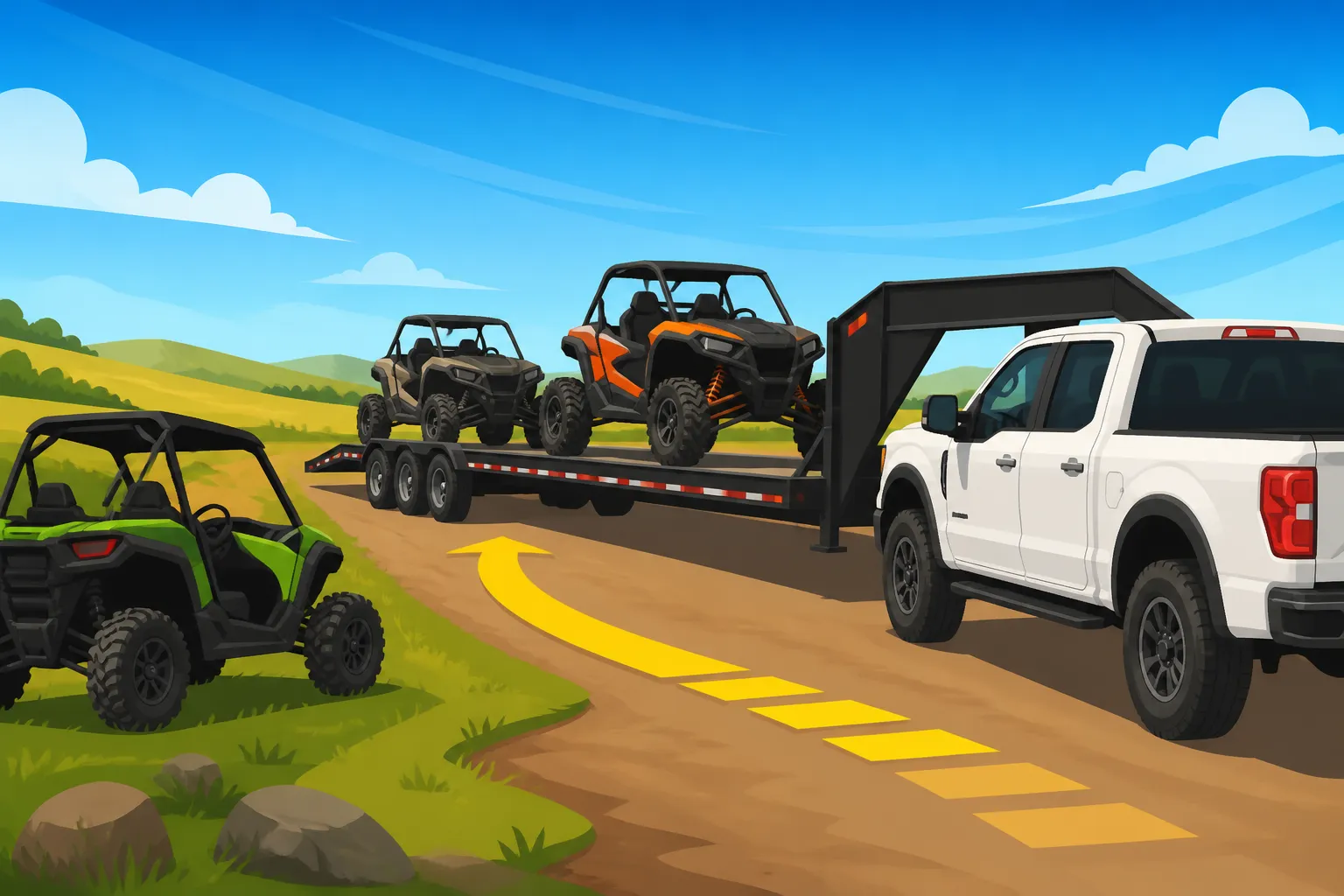
The most difficult part of parking a long trailer is often not the parking space itself; it is getting into position. A tight turn can cause the trailer wheels to track inside the path of the truck, while a narrow entrance can leave little room to correct your angle. Before turning off the road, slow down and look for signs, traffic, soft ground, and anything that limits the swing of the trailer.
If you have a passenger, agree on a simple spotting plan before arriving. Decide where the spotter will stand, how you will communicate, and when you will stop if either person loses sight of the other. The spotter should remain visible in the driver’s mirrors and stay clear of the truck’s wheels, trailer wheels, and any pinch points. If you cannot see the spotter, stop rather than guessing.
Do not let a line of vehicles behind you pressure you into attempting a maneuver you have not assessed. Pull over only where it is safe and lawful, let traffic pass if appropriate, and take another look at the space. A few minutes spent evaluating the turn is far easier than trying to recover from a trailer jackknife or a wheel dropped into a ditch.
Park so you can leave without creating a hazard
Whenever possible, position the rig so you can pull out forward. That may mean choosing a less convenient space or adjusting your approach before unloading. If backing is unavoidable, use a spotter and move slowly. Keep checking both sides of the trailer, since the driver’s view can make one corner appear clear while the opposite side is close to a post, vehicle, tree, or ditch.
Avoid blocking gates, roadways, trail entrances, turnaround areas, or access needed by other visitors. Keep the truck and trailer fully out of travel lanes, and do not use private driveways or open ground as overflow parking without permission. A trailer that only partly blocks an entrance can still make it difficult for another vehicle—or an emergency responder—to get through.
Once parked, check that the trailer is stable before unloading. Choose firm, reasonably level ground when available, set the parking brake, and use wheel chocks if you carry them and they are appropriate for the surface. Keep loading ramps and machines clear of traffic. If the ground is uneven or soft, think carefully before driving a heavy trailer farther in; getting in is only half the job if you cannot get back out.
Consider a smaller rig or a different staging plan
If your trailer is especially long, wide, or difficult to maneuver, compare your options before the trip. A shorter trailer, a separate tow vehicle, or a different approved staging location may make the day easier. Do not plan on leaving a trailer somewhere merely because the entrance appears too tight; an alternate location should be legal, permitted, and safe for both the trailer and other road users.
When several people are traveling together, coordinate arrival times and parking choices in advance. One vehicle can arrive first to assess the area, but it should not reserve space by blocking access or occupying an unauthorized spot. If there is no appropriate place for the full group’s trailers, split the group’s staging only when everyone knows where to meet and the arrangement does not create a traffic or access problem.
Mapping tools can help you review the route and nearby roads before leaving. Some riders use onX Offroad to inspect mapped routes and orient themselves around riding areas, but a map is not permission to park on private land or a substitute for signs on the ground. Use it as one planning aid, then follow posted directions and confirm access when the parking situation is uncertain.
Prepare for changing conditions around Turtle Mountain
Wet ground can make a manageable parking space risky
A firm-looking entrance can become slippery or soft after rain, and a heavy truck-trailer combination can rut ground quickly. If the weather has been wet, consider whether the approach and parking area can support your rig before committing. A spot that seems easy to enter may be difficult to turn around in once the trailer tires begin to sink or slide.
Check conditions close to your travel day, and be ready to postpone or change plans if the route or staging area is unsuitable. [North Dakota Trail Status by App and Phone] can help with trail-status planning, but also check applicable local updates and posted notices for access or parking information. Trail status and vehicle access are related but not identical: an open trail does not guarantee that every approach or parking surface is in good shape.
Wet clay and soft ground can also make it harder to keep a trailer straight while backing. If you see standing water, deep ruts, or a shoulder that gives way underfoot, do not assume the truck’s weight will be harmless. [North Dakota Riding After Heavy Rain] and [North Dakota Riding in Spring Mud] offer further context on how weather can affect a riding day. The safest choice may be to keep the trailer on a firm, appropriate surface rather than trying to force access.
Bring the right equipment and keep it accessible
A basic towing and recovery kit can make a small problem easier to manage. Depending on your setup, that may include wheel chocks, a properly rated tow strap, gloves, a tire-pressure gauge, a jack suited to your vehicle, and tools for securing ramps or trailer doors. Store essentials where you can reach them without unloading machines or standing in the roadway.
Before leaving home, inspect the trailer tires, lights, hitch connection, safety chains, and loading ramps. Confirm that the load is secured and balanced according to your trailer and vehicle manufacturers’ guidance. A trailer that sways on the highway or shifts during a slow turn is much harder to handle in a confined parking area.
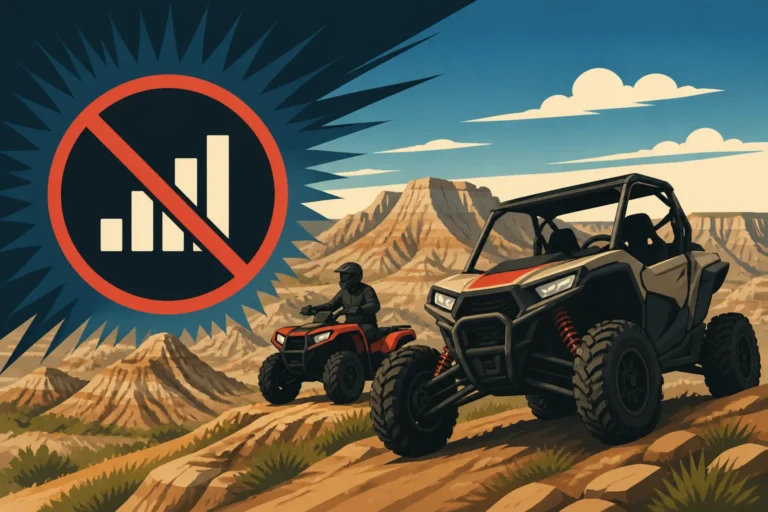
Plan for limited phone service as well. Download maps or route details ahead of time, let someone know where you are going, and avoid depending on a single phone for directions and communication. onX Offroad may be useful for reviewing mapped riding routes, but keep a backup plan—such as saved directions or an offline map—so you are not forced to stop in an unsafe spot while trying to find your way.
Use good trailhead etiquette when space is limited
Leave room for other riders and local traffic
At a small staging area, the way you park affects everyone who arrives after you. Leave enough room for other vehicles to enter, unload, and turn around. Do not spread equipment across a shared access lane, and keep machines, ramps, and gear close to your own truck and trailer. If someone needs to pass, move only when it is safe and do not create a new obstruction while making room.
Be considerate of nearby residents, landowners, and other road users. Keep noise and dust down when practical, avoid blocking approaches, and never assume an unmarked field edge is public parking. If a location is posted or access is unclear, choose another lawful option or ask for clarification instead of testing the boundary.
[North Dakota Trail Etiquette Locals Expect] is relevant well beyond the trail itself. Respectful staging helps keep access pleasant for other riders and reduces the chance of conflict at a limited parking area. A calm, patient approach matters especially when several groups arrive at once and everyone is trying to unload.
Make a backup plan before you start towing
Before the trip, decide what you will do if the planned space is full, closed, muddy, or too tight for your trailer. Identify a safe place where you can pause without blocking traffic, and know whom to contact for reliable access guidance. Do not rely on turning around wherever the road seems wide enough; a long trailer may need more room than the driver can judge from the cab.
A simple arrival checklist can keep the decision-making manageable:
- Confirm the entrance and route before leaving.
- Check current access and weather conditions.
- Look for posted parking instructions when you arrive.
- Assess the turn, ground firmness, and exit path before entering.
- Use a spotter for tight maneuvers and stop if communication is lost.
- Park without blocking gates, roads, trail access, or turnaround space.
- Reconsider the plan if the site is crowded or unsuitable for your rig.
If you are unsure whether your trailer can be accommodated at Sjule Road, confirm before towing there and be prepared to use an approved alternative. Arriving with a backup plan is not overcautious; it is often what keeps a relaxed ride from beginning with a difficult recovery or an avoidable parking dispute.
Disclaimer
This article is for general informational purposes only and does not constitute professional advice. Laws, prices and regulations vary by location and change over time. Consult a qualified professional for guidance on your specific situation.